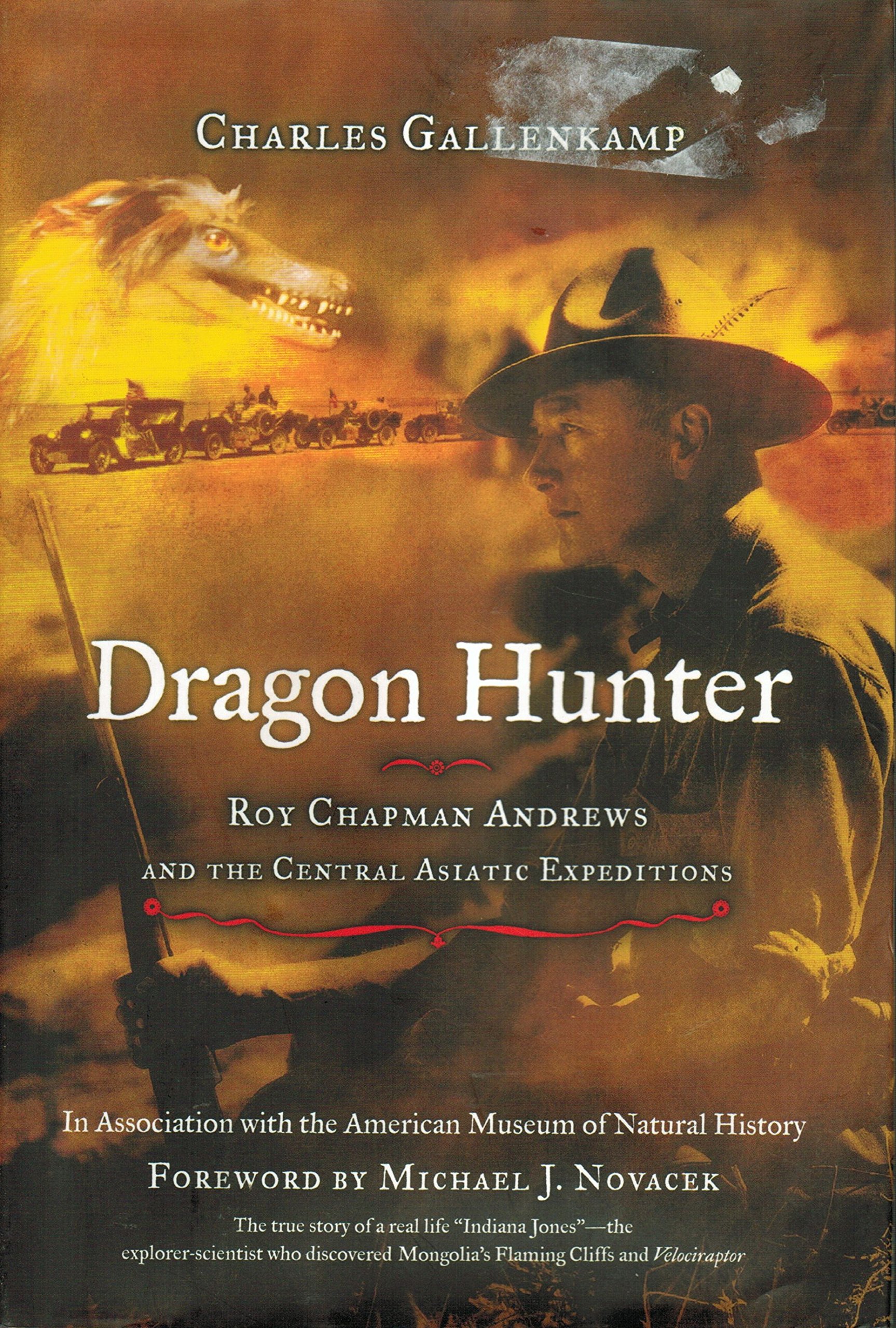
Dragon Hunter: Roy Chapman Andrews and the Central Asiatic Expeditions
B**T
HE WASN'T BORN IN INDIANA, BUT OTHERWISE....
This is a great rollercoaster ride of a book. As the saying goes, a novelist couldn't dream up the real adventures that Roy Chapman Andrews lived through. Right from the get-go, Andrews had incredible energy and before he was 30 he had accomplished more than most people do in a lifetime!As a teenager, Andrews, using a book on taxidermy as a guide, taught himself to mount animals and birds. As the author explains, "He soon became so skilled that he acquired a license from the Wisconsin Conservation Department and started a part-time business mounting trophies for hunters, the proceeds from which paid for most of his college tuition." Andrews always knew what he wanted to do for a living and he went right after it... To quote Andrews, "Actually, I never had a choice of profession. I wanted to be an explorer and naturalist so passionately that anything else as a life work just never entered my mind."After college, even though he had received a letter from the director of the American Museum of Natural History in New York stating that they had no job openings, Andrews went to New York anyway and showed up at the museum. With his combination of charm and determination he convinced the director to hire him. Andrews started off as an "assistant", basically doing janitorial services, but quickly worked his way up. Still only 23 years old, he was sent by the museum to salvage the remains of a North American right whale that had washed ashore in February 1907, at Amagansett on Long Island. The museum wanted the whale for its cetacean collection. In 20 below zero farenheit weather, Andrews and another museum employee, along with local fishermen, started to "excavate" the whale from the sand. After a couple of days of backbreaking work a severe winter storm struck the area and reburied the whale. Andrews and his co-worker had to start all over again, and it took them a further 10 days to accomplish their goal.After that, Andrews was off to the races. The museum sent him out to shore-whaling stations in British Columbia and Alaska to gather anatomical data on whales. Andrews started to write papers on various topics. When he got back to New York he began attending Columbia University so that he could pursue a doctorate in zoology. In his anatomy studies he became quite adept at dissections. His instructor, a prominent surgeon, was so impressed with Andrews' skills that the instructor thought Andrews should pursue a career as a surgeon! Andrews also gave a lecture and slideshow and did so well that he got a standing ovation. He was invited to participate in a lecture program sponsored by the city's Department of Education. At this point, we are only up to 1908-1909 and Andrews was only 24-25 years old.I hope this gives you some idea of how interesting and exciting Andrews' life story is. All the Central Asiatic Expeditions, with howling sandstorms, civil wars and vicious bandits are still to come!This was easily one of the best books I've read in the past year. In what is always a great tribute to a wonderful story, I wish I could wipe my memory clean and start it all over again!
M**R
Better Han Indiana Jones’ adventurous spirit.
Have you ever wondered who brought back those wonderful old bones that form the basis of the ( NYC) American Museum of Natural History ‘s paleontological exhibits? This is the true account of the explorer/ paleontologist Andrews and his successive 1920’s treks throughout the inhospitable Gobi desert. The journeys were not for the faint of heart. A wonderfully enjoyable and informative book.
W**E
Interesting book
Great book, delivered as described we would order from them again.
H**N
Dragon Hunter
This is very good account of expeditions undertaken the early part of the last century. This was a time of the first Ford trucks and unknown lands. Imagine camelspacking gasoline for the trucks across an endless expanse.So much unthought of knowledge is contained within the writing that there are surprises every few pages.
K**M
RC Andrews
What a buy! Got it for my son and he had the unexpected good fortune to open it up and have $12 slide out that he thought we had tucked inside! Not us (unless my sleepwalking has me dishing out money to the kids!). Great read though for any wanna be digger of bones!
M**N
Where Indiana Jones got his inspiration.
This guy was s rock star in his day. My 96 year old aunt and my 92 year old mom both concur. The book is a straight ahead account of what it takes to be a true explorer.
M**A
The biograpy of a larger than life American Explorer
I sincerly confess not having known anything about Roy Chapman Andrews before reading Gallenkamp's fascinating biography. However, this book not only condenses practically all the facts of this 1920 explorer and naturalist's life, but also presents an enlightening panorama of the mentality, the political and economical situation and the cultural drives that allowed the Central Asiatic Expeditions.Roy Chapman Andrews left quiet a few writings on all his feats, and the impression is that Gallenkamp has based his biography mostly on these, without examining thouroughly secondary fonts, such as coworkers, friends and relatives.As I have understood reading the book RCA was a controversial figure even in his times. He incarnated the typical brash, conceited, aggressive and self assured, and might we say "racist" (?) "Americano all'estero" (American abroad) that was widely accepted and admired in his country, but lay a little indigested on the stomach of the Nations that had to put up with him. However, he had a will of iron and harboured together with his mentor Osborn "a great dream", backed up by sound American dollars and the technology that consented the ground breaking Central Asiatic Expeditions. Looking for the "Missing Link" between the apes and man in Mongolia, he actually found many species of then unknown dinosaurs and primitive mammals and assured the Museum of Natural History the greatest collection in the world of these specimens.One of the strong points of this biography is the explanation of the technical characteristics of these expeditions. The revolutionary importance of the use of automobiles to explore the desert and how these had to be refurnished by caravans. Another very interesting aspect is the description of attitude of the American society of the 1920 toward scientific exploration and how it evolved during the Depression and after, together with the evolution of the situation in China and Mongolia.If one has the curiosity to read some of Owen Lattimore's books, written just ten years after (The Desert Road to Turkestan, High Tartary, etc) the political situation becomes increasingly clear.As has been justly underlined eventhough the book contains many beautiful photographs and drawings of dinosaurs, we do not learn much about zoology or the purely scientific aspects of Andrews discoveries.As a period piece and biography this book is truely excellent, but it does leave a few questions unanswered stimulating the reader's curiosity to look for more information.
P**T
A great read for anyone heading to Mongolia
A fast paced biography of Roy Chapman Andrews, the man who led the expeditions to Mongolia that discovered the dinosaur eggs. A great read for anyone heading to Mongolia.
Trustpilot
2 months ago
3 days ago