Full description not available
J**R
The Ultimate Insider Look on Hollywood History
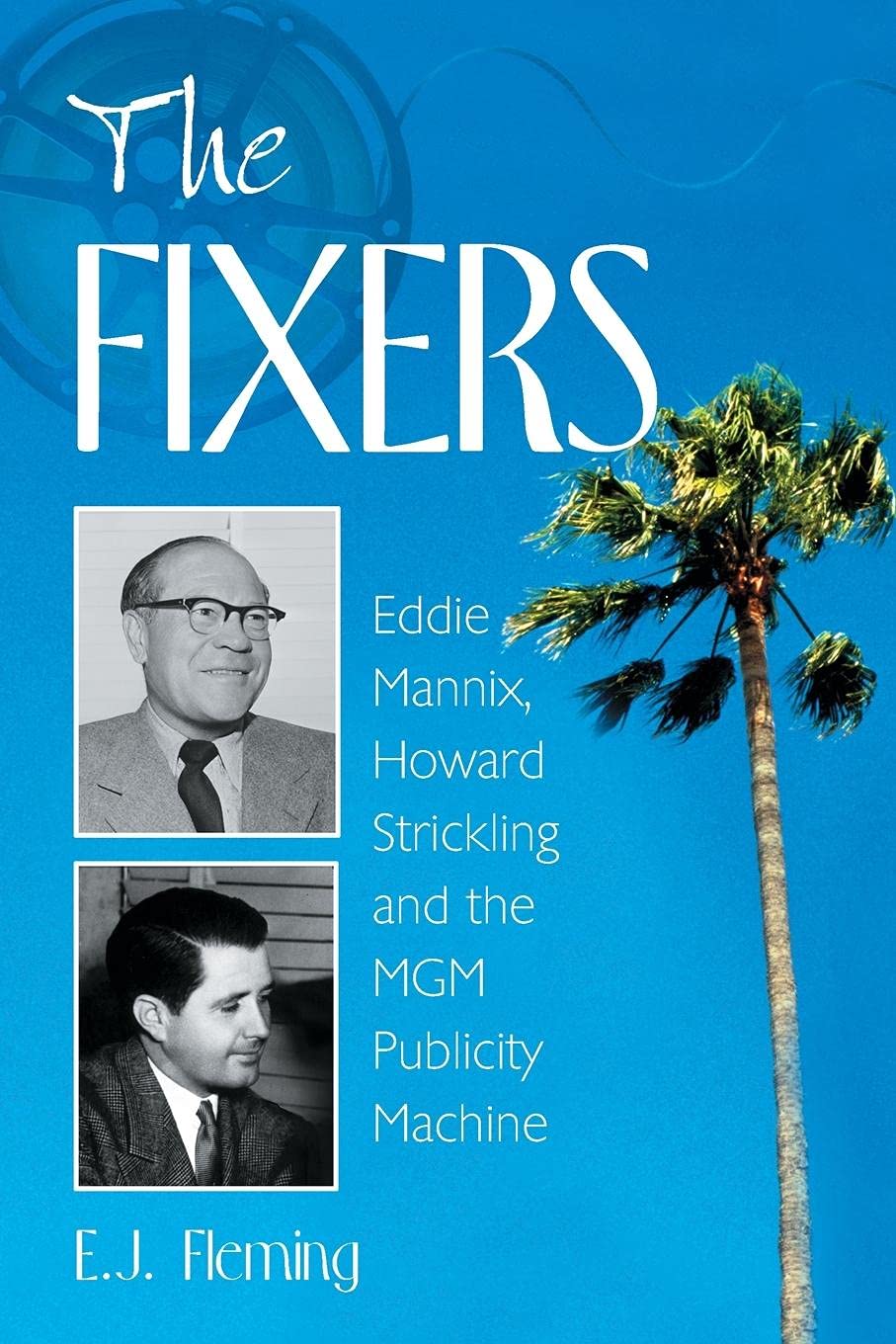
This book is a real page-turner. Certainly one of the more eye-opening accounts of the Golden Age of Hollywood. It serves many purposes.It is first of all a history of the Golden Age of Hollywood. The book has a difficult time getting started, though. It begins with a history of the movie industry, from the very beginning. And when I say “from the beginning,” I mean it. Literally from the late 19th Century. The history proceeds further and travels along with the careers of Eddie Mannix and Howard Strickling.This is not an ordinary history of Hollywood. From this rather laborious beginning, I literally could not put this book down. This history is told through the media manipulations and interventions of Mannix and Strickling to preserve the public image of MGM’s biggest stars. Eddie Mannix and Howard Strickling were the Hollywood “fixers.” If there was a problem with a major star — an unsavory personal fact, a drug dependency, an arrest, a death, a sexual deviancy, an unwanted pregnancy, a DUI, literally any PR problem that could tarnish the star’s image — they fixed it with the press, and if needed, law enforcement. This usually involved some degree of advanced public relations, such as issuing phoney press releases or some other form of disinformation, but frequently involved the transfer of cash to public officials or the private parties affected, hiding guilty parties, or whatever it took to handle a potential scandal. It is a form of media manipulation not widely found in the celebrity world nowadays, although their techniques are regularly practiced on a daily basis by the government.To give you an idea of how smooth these fellows were, consider an incident from the life of Clark Gable. In 1933, Clark Gable, very drunk, hit and killed a pedestrian on Sunset Boulevard — and then drove away. He called Strickling in a panic. Strickling contacted and hired Jerry Giesler — a celebrity lawyer, who deserves a book about his own legal career, and who successfully defended Error Flynn in his statutory rape case — and spirited Gable to the high desert, ordering him to stay put for a while. Mannix arranged the settlement of the personal injury claim of the private party. The private party’s family was paid off; they were paid $400,000.00 in 1933 dollars. Mannix could not fix it with the D.A., however; it was, after all, vehicular manslaughter. So he had a straw man take the blame instead. According to the arrangement, whoever took the blame for the accident would be guaranteed a life-time salary from MGM. The fall guy submitted to an inquest, and, fortunately, perhaps not surprisingly, the fall guy was not found criminally liable. Still, after all was said and done, the fall guy took an extended European vacation until things calmed down, only to return to an illustrious career in Hollywood. Brilliant! These guys were smooth operators. The name of the “fall guy”? John Huston. Coincidence? Gossip? There are no newspaper accounts of a traffic death involving Clark Gable, — nothing. But there were newspaper reports of a traffic death on Sunset Boulevard with the same date and time Gable ran over the pedestrian, identifying the guilty party as John Huston by name.This is only one of the many, many inside stories in this book. You see, this is the other way this book may be approached. This book can be considered as containing nothing but gossip, or being the ultimate insider look into the Golden Age of Hollywood. The book mentions well-known, notorious, episodes in Hollywood history, and offers completely credible inside glances of what was really going on in the background. For instance:Fatty Arbuckle. At one time he was more well-known than Charlie Chaplin. History records that he was involved in a murder trial in San Francisco and it is generally accepted that he was set up. This book delves deeper in the story. Fatty was led for public slaughter by the Hollywood moguls who essentially abandoned him by failing to provide back-up or public support. Their reason? The Hollywood moguls felt that he had earlier “extorted” into giving him an enormous salary against their intentions.Or Francis X. Bushman. A film star essentially unknown today, but very successful in his heyday. He was ostracized by the Hollywood elites because he very publically carried on an affair with a drop-dead gorgeous eighteen-year old, an act which outraged the conservative sensibilities of Louie Mayer. Mayer was apparently jealous.There have been some reviews that have disparaged this book because it contains “Hollywood Gossip.” This may or may not be true. The author declares that the contents of the book have all been verified and confirmed by corroborating sources. Indeed, there are approximately twenty pages of footnotes. As with any insider book such as this one, however, some degree of gossip mongering is unavoidable, because the written record is a sanitized version of the real events. This is a casualty of the types of problems Mannix and Strickling fixed. The types of problems Mannix and Strickling fixed consisted of sordid, salacious, real-world problems of real persons who happen to be professional actors. This book lifts the veil of celebrity and takes the real look at these celebrities.But even if it is all just “gossip,” so what? C’mon now, admit it. Don’t you, the reading public, really WANT to read gossip? Isn’t that what we want to read? Isn’t gossip more interesting than the “truth,” which can be variable and itself dependent on whomever is telling the story?This is the ultimate insider book. This is an engrossing and gossip or not you will be glued to the pages.
K**R
It was interesting
At first it didn't seem to be very much about Mannix or Strickling..but then again, the author did need to give some history of making movies, studios, Hollywood..and of course actors and actresses. They did indeed protect MGM's stars.. sometimes for a very begrudging Mayer, but overall, they were protecting MGM.It was scandalous and sad with some of the things that they got away with doing..worse was the fact that they had several people in their pockets making the law go out the window. Some of the small to medium details differ with some other books that I've read that are fairly recent. Some information I already knew and some of it I didn't. Some events got cleared up, and some are still a mystery. How much of the information was a plant to keep Stars inline.. and we just still believe it? Judy Garland lived such a sad life for someone so talented. It makes you appreciate the stars that lived a more reputable life and weren't extremely crazy. But, now I can put a back story and face to the "Fixers" and the events that they had to..fix.
J**L
What you may have missed about old Hollywood.
If you are a fan of old Hollywood, and the sordid side of the studio system, this book is for you. Many stories and incidents are covered here....or perhaps 'uncovered' with updated factual info that we were not aware of.Studios 'owned' their stars and MGM was no exception...in fact Louis B. Mayer was likely the most powerful of the movie moguls. He molded the image of his stars and everything was done to protect that image....lawful or unlawful.
T**F
Fascinating -- but frustrating
I had been meaning to read this book for years and finally got around to ordering it. I found it to be both fascinating and frustrating. Fascinating that these two guys -- and their bosses -- could literally "write the laws" of Hollywood -- who got prosecuted, or not, for what. There is plenty of fun information on the stars you always expected to be trouble.But at the same time -- Mr. Fleming: If this EVER goes to a second printing, for God's sake GET A PROOFREADER. Typos and factual errors abound (did you know that the Marx Brothers made a movie called "Monkee Business?" yeah, news to me too), sometimes on names of people whose names are spelled correctly in other parts of the book ("Marie Dresser?" Really???). What's more, more than once I noticed almost identical sentences about various events within pages of each other.Now -- back to fascinating: Fleming's theory on the death of George Reeves does make more sense that anything I've ever read about it. It's a pity he wasn't around in the 1950s to investigate the case, but then maybe Eddie Mannix would've had him whacked...Recommended, but you've been warned.
Trustpilot
3 weeks ago
3 weeks ago