
DOWNLOAD THE APP


Customer Services
Copyright © 2025 Desertcart Holdings Limited
DOWNLOAD THE APP
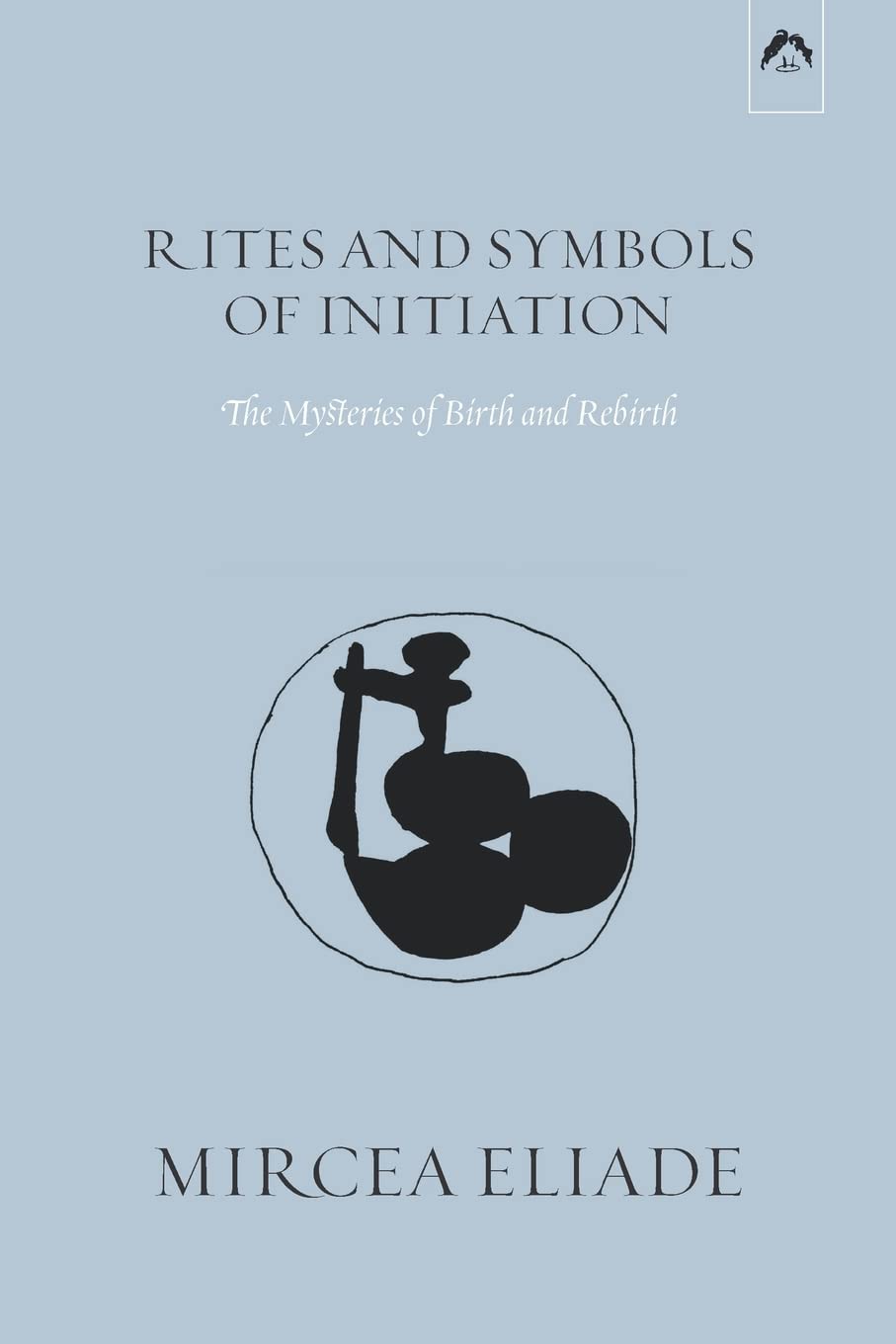
Rites and Symbols of Initiation: The Mysteries of Birth and Rebirth
P**Y
A Critical Text of Existential Influence on Modern Fiction
This well-researched and thoughtful volume is not only arguably the finest work about Percy and his writings, it’s one of the best literary criticism works I’ve ever encountered as it expertly and carefully addresses all of the key, classical texts and influences that Percy used to shape his beguiling novels. An absolute must-read for fans of Percy as well as anyone interested in the powerful, insightful influence of existentialism on contemporary fiction.
R**D
A brilliant study
I highly enjoyed this book. I liked how the author blended the disciplines of theology, anthropology, philosophy, and psychology. What was especially striking to the me is how many similar correspondences could be found across various cultures regarding how people would be initiated and the various yet similar ways this was done.Finally, I loved how the author reminded us of some of the wonder we have lost as we in modern and postmodern society lose our grasp of the language of symbolism, and how much it enriched the lives of the ancients. I highly recommend this book to the deep thinker.
C**S
Important classic, worth reading
In this work, Eliade explores the general approaches to initiation found among archaic cultures and how these have survived or not in historical traditions. While the work can in no way claim to be complete, it is a classic in its field, like so much of Eliade's work.Eliade utilizes a comparative methodology in looking for universal or nearly universal patterns in comparative religion. Here he looks at archaic initiation ceremonies in the Americas, Australia, and Africa, and compares these with India, Christianity, and historical Greece. The general parallels in symbolism and patter that he shows are quite meaningful and can help people understand related topics.Highly recommended for anyone studying this topic.
A**N
A classic and important text - dense but fascinating
This is one of the major ethnographic and sociological texts, indeed a landmark in the philosophy and science of consciousness transformation - what it is and how it has been practiced around the world, from coming of age to shamanic development. Casts light on the various arcana of human history including the unwritten lore that has so influenced the world. Consider for example that Mandela was initiated to be a man in the traditional ways of his native tribe
B**R
The Great Mercea Eliade!
Practically anything, including this book, written by Mircea Eliade (1907-1986) is a phenomenal read! He is a MAJOR figure in the study of the history of religious ideas. Romanian historian of religion, fiction writer, philosopher, and professor. He was a leading interpreter of religious experience, his paradigms in religious studies persist to this day. His theory that ideal models of divinity form the basis of religion, splitting the human experience of reality into sacred and profane space and time, has proved influential.Fluent in speaking and writing Romanian, French, German, Italian, and English, with a reading knowledge of three others, Hebrew, Persian, and Sanskrit.Between 1925 and 1928, he attended the University of Bucharest's Faculty of Philosophy and Letters in 1928, earning his diploma with a study on Early Modern Italian philosopher Tommaso Campanella. In 1927, Eliade studied in Italy, where studied philosophy, religion and logic. After receiving a four year scholarship to study at the University of Calcutta Eliade also made a large tour of Egypt and stayed at a Himalayan ashram for a short time. In Calcutta he studied Indian philosophy, Sanskrit, Pali and Bengali. During this time, he studied and met Mahatma Gandhi, and adopted Ghandist ideas. Eliade received his PhD in 1933, with a dissertation on Yoga practices. During the same period, Eliade began a correspondence with the Ceylonese-born philosopher Ananda Coomaraswamy. In 1936, he made trips to London, Oxford and Berlin.During WWII, Eliade supported Facist, far right ideas such as those put forth by Italian dictator Benito Mussolini and opposed democracy (as managing to crush all attempts at national renaissance.)I'm not sure I support him here, but that was certainly a different time and place.By 1945, Eliade lived and worked in France. In 1957, he joined the faculty of the University of Chicago, and is generally admitted to be, along with Joachim Wach, the founder of the "Chicago School" that basically defined the study of world religions for the second half of the 20th century. Upon Wach's death, Eliade was appointed as his replacement in 1964,to the Sewell Avery Distinguished Service Professor of the History of Religions.In 1966, Mircea Eliade became a member of the American Academy of Arts and Sciences. He also worked as editor-in-chief of Macmillan Publishers' Encyclopedia of Religion, and, in 1968, lectured in religious history at the University of California, Santa Barbara. It was also during that period that Mircea Eliade completed his voluminous and influential History of Religious Ideas, which grouped together the overviews of his main original interpretations of religious history. In his later years his writing was severely hampered by arthritis. The last academic honors bestowed upon him were the French Academy's Bordin Prize, in 1977 and the title of Doctor Honoris Causa, granted by the University of Washington in 1985.Truly a remarkable man! If you have not read any of his books look at his page on Amazon and pick on, buy it and READ it!
D**O
Wonder condition, quick delivery!
The book was exactly as described! Thank you for the quick delivery!
L**D
Good research book.
It is a text book which covers the topic I am researching on initiation in the modern era. The topic is well researched in this book and presented the information I needed. My topic is the lack of initiation of boys into manhood and the effects it has on our society.
T**K
Brilliant
It is a brilliant insight and model of human behavior and initiation rites. Working from pre-historic initiation rites through the post modern period it opens up and identifies what we may have lost as a civilization.
Trustpilot
3 weeks ago
3 weeks ago