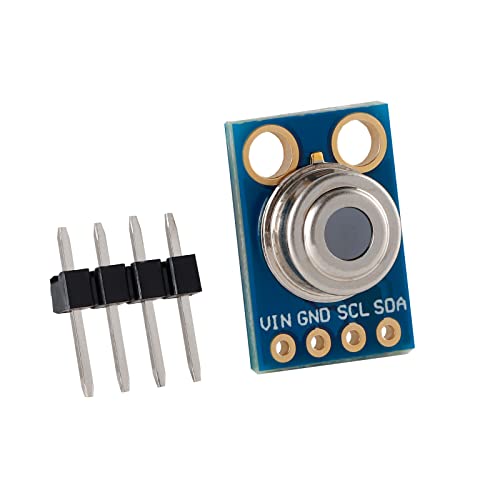


🌟 Measure the future, without touching it!
The EC Buying GY-906 MLX90614 is a high-precision, non-contact infrared temperature sensor module featuring a 17-bit ADC and DSP for ultra-accurate readings with 0.02°C resolution. Compact and easy to integrate via IIC or PWM interfaces, it covers a broad temperature range (-70°C to 380°C) and is factory calibrated for reliable performance across diverse applications from industrial controls to body temperature monitoring.


| ASIN | B0B63K5V7T |
| Best Sellers Rank | #73,269 in Industrial & Scientific ( See Top 100 in Industrial & Scientific ) #111 in Temperature Probes & Sensors |
| Date First Available | July 8, 2022 |
| Item Weight | 0.634 ounces |
| Manufacturer | EC Buying |
| Package Dimensions | 5.28 x 4.29 x 0.28 inches |
W**O
Funciona bien
I**B
Works really well
No problem interfacing to an Arduino Uno or a Nano. I used the Adafruit tutorial for guidance and had it integrated into my project very quickly.
O**D
Works well - very happy with this sensor
I rigged up a pretty good test for this sensor, and according to the data it did pretty well. See the images. The test was this: * I put a sketch on a nano to stream ambient and object temps to stdout, and wrote a script to provide those readings to prometheus. * I wrote another script to grab thermocouple temperature readings from my bench DMM to provide those readings to prometheus as well. * I "thermally coupled" the thermocouple to a small black heat sink, and positioned that just above the IR sensor's "lens" at a fixed distance * Put together a dashboard in grafana to show all the data in a time-aligned way * Shot hot air at the heat sink being sure to angle the airflow upwards so as not to disturb the sensors notion of what the ambient air temperature is. The graph shows the result, which IMO looks pretty good. I would give this sensor 5 stars but I think it might be a bit too expensive. Otherwise - it works great. Four stars.
N**M
Beat my expectations
I always wanted to make my own IR thermometer & this sensor was exactly what I needed !
T**H
Perfect for my cloud monitoring project
This small IR thermopile board is exactly what I wanted to build out a cloud monitor. I purchased two of them in case I needed a down-looking measurement as well. Very small and extremely easy to use in any MCU or SBC.
D**R
Should work great for measuring belt temperatures
Review of ”EC Buying - GY-906 MLX90614 Non-Contact IR Infrared Temperature Sensor...": (Please refer to my reviewing guidelines at the bottom of the page). I am a retired professional engineer and my wife and I live on our 52' Trawler style boat 100% of the time and anchor out and travel 99% of the time. I've developed a vessel control and monitoring system that uses touch screens on a N2k type CAN (common area network) buss. It can control and monitor nearly every system on the boat including the propulsion engines, generators, active stabilizers, alternator regulation/outputs, solar, battery charging and monitoring, lights, blowers, pumps, etc... In the above system I am also monitoring alternator temperature and vary it's output when it begins to show heat stress but I am currently developing a method of also monitoring the engines belt temperatures. When a belt stretches it starts to slip causing friction and heat until it gets to the point of destroying itself and the heat it generates can even cause the alternator or pump harm by burning out the diodes, impellers, or at a minimum burning away the bearing grease. I've ordered this GY-906 non-contact temperature sensor to use in that project. I haven't installed these yet but I've inspected the board and it looks well made other than the solder resin that wasn't cleaned up. I've also done a bit of internet research under the module name and understand that there are a number of libraries available so it shouldn't be too difficult to install in my network. I still have the mounting hardware and enclosure to manufacture but when I've got it all built, tested, and installed I'll update this review. BTW, this is the 3.3 to 5.5 volt version because it has the 3.3v regulator mounted on the backside. My responsibility as an Amazon Vine Reviewer: Considering the Amazon rules/regulations for being a Vine Member It is obvious that it is very important to Amazon that the person doing the review has indeed inspected, tested, used the product as well as being aware of the competitive situation of the market segment. This is so it can be fairly compared and reviewed whether good, bad, average, or anywhere in all of the grey area between. One thing that I wish were better defined by Amazon is exactly what each star should represent from 1 to 5 so that every Vine member would use the same guide in that regard. So, to let you know the guide that I use, I include it as follows: I always start off considering that average is 3 stars, and an average rating to me is: The product was correctly represented in the ad. The manufacturing quality is as expected. The product performed as intended. The product operating/user guide if needed is helpful. The product is priced accordingly. Then after inspection, measuring, testing, using, wearing, or whatever is required I add or subtract from the average as follows: Subject to additional stars: Additional product features not expected that are useful. Manufacturing quality/performance above what was stated or expected. Included guides and/or useful information that is beyond the norm. Product pricing highly competitive for a superior product. Subject to fewer stars: The product was misrepresented in the ad. Manufacturing quality/performance below what was stated or expected. No useful guide or understandable user information when required. Product pricing is on the high side considering quality, features, or the market. all the best, dr
J**.
Well executed, down to the detached header
More than a MLX90614 sensor, this is a complete module that spares you the extra work of wiring up resistors and capacitors. The manufacturer was smart to include a four-pin header but not solder it in, in case you want to attach the module some other way. (It's easier to solder if you need it than desolder if you don't.) I was able to get a reading in a matter of minutes with my Arduino Uno R4 using an Adafruit library for this sensor type and its included mlxtest sketch.
M**.
Bare non-contact temperature sensor for DIY non-contact thermometer
This product is a GY-906 module, with the MLX90614 as the core chip, working as a non-contact IR infrared temperature sensor. It works well and as advertised. It does come with a 4-pin header/jumper pins, but NOT soldered. So, the soldering effort is needed. It uses I2C as the interface to send live data, which most MCU like Arduino or Raspberry Pico have that too. The temperature measured I considered accurate. The object needs to be measure at a distance of around 1cm from the sensor to have a "good" and reliable reading. That is actually pretty much the same as most "commercial forehead thermometer". As a result, it is great for making a DIY own non-contact IR thermometer. There is no other accessories or printed material comes with. It is better to save all information ahead of time from the website/product description for future reference.
Trustpilot
5 days ago
1 month ago