
DOWNLOAD THE APP


Customer Services
Copyright © 2025 Desertcart Holdings Limited
DOWNLOAD THE APP

⚙️ Build it. Power it. Own the science of motion.
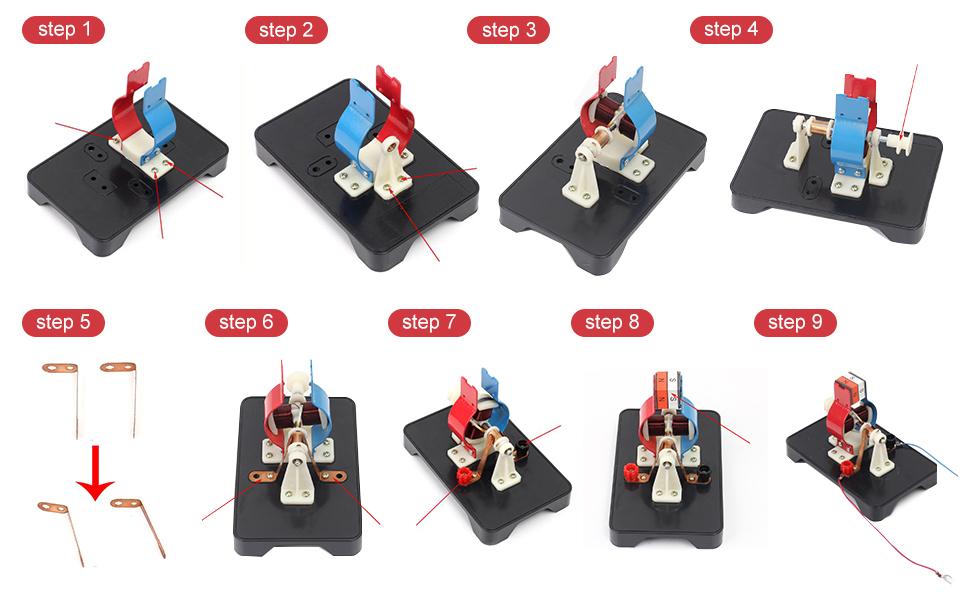
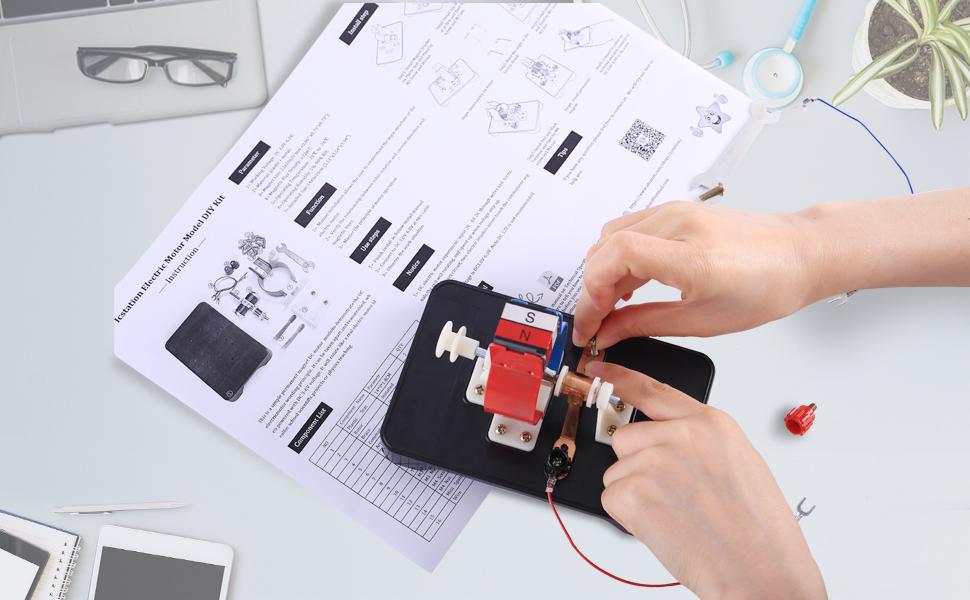
The Icstation Electric Motor Kit is a compact, easy-to-assemble 3-6V DC motor model designed for educational use. Featuring a strong permanent magnet and clear DIY components, it offers a hands-on experience to explore motor mechanics and energy conversion, making it perfect for STEM learners, hobbyists, and educators.







| ASIN | B073GXWQMV |
| Best Sellers Rank | #168,656 in Industrial & Scientific ( See Top 100 in Industrial & Scientific ) #502 in Soldering Stations |
| Customer Reviews | 4.1 4.1 out of 5 stars (262) |
| Date First Available | June 29, 2017 |
| Is Discontinued By Manufacturer | No |
| Item Weight | 7.3 ounces |
| Item model number | Simple DC Electric Motor Model Kit |
| Manufacturer | icstation |
| Product Dimensions | 3.15 x 1.8 x 0.5 inches |
J**Z
Very fun and safe little project to learn about DC Motors
I bought this as a toy to play with and eventually so that my kids can play with it and get to learn about electricity in the process. Putting it together is very simple and straightforward, although it may be a bit confusing due to the images in the manual being black and white and thus making it a bit hard to identify how components go together. I ended up using common sense and following the labels of the images. The wording is a bit confusing but it’s much better than other hobby kits. I spent about 20 minutes putting the kit together and it was very fun! The parts are well made, and fit together quite good. Tolerances seem pretty good for a toy. The magnet is surprisingly strong. The kit even came with a small wrench to help tighten the nuts. I plugged it in with a constant current and constant voltage power supply I bought to power this motor. I set it up to output 6V @ 1.5A max and it worked fine. At first it was very noisy, but I put some PTFE-based lubricant on the bushings and it ran much smoother, faster and overall more efficient. I think it could be used as a generator, I tried turning the motor with my hand and measuring the output voltage and it seems to output some voltage, which I find very interesting, especially because I can eventually teach my kids about power generation.
L**M
Fun, educational kit
I purchased this motor kit to give to my grandson who is 16 so he can learn how motors work. Before giving it to him, I assembled and tested it. It is fairly easy to put together although the instructions could be a little clearer as there are 2 screw sizes and the instructions do not state which size goes where. Initially I assembled it wrong and then had to remove the screws and put the correct ones in their intended places. Once assembled, I used 2 AA batteries to provide 3V since the instructions say to power with between 3 and 6 volts. However, I was not able to get the motor turning. I then connected it to a bench supply capable of delivering up to 3 amps. From what I saw, it takes about 1 amp to get the motor turning, but when it does, it highlights the physics behind how a motor operates. I also connected it as a generator and was able to get a voltage reading across the leads when I spun the motor by hand. It was a fun project and I have disassembled the kit to give my grandson so he can get the benefit of building it and studying how it works. One improvement would be to include a pamphlet that describes the operation of motors and generators so that users can see the science in action.
R**B
Works exactly as expected. Also make a loop motor on your own to teach kids.
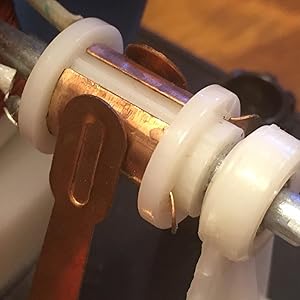
The motor worked as advertised, and as other reviews indicated, the assembly instructions were poor but quite easy to figure out. See photos of instructions, they are really bad (almost blacked out) black and white copies where you need to see the photos. However the parts list on the other side was helpful (I had all parts). I've attached some photos of final assembly so you can see how the parts fit, including a view of the bottom. Regarding starting the motor: as other reviewers have said, don't start it with it shorted. See the two close-up photos. The motor will default and roll into the "bad" position (2nd photo) where the arms are touching the middle of the copper area. Every time you start it, you need to roll it so that the white non-copper part is in the middle of the arm (1st photo). If it is shorted (bad position) when you start when you are holding the wire to a battery with your finger (or the child's finger), the wire will get very hot quickly. (ouch) Yes you could add your own switch but I didn't bother. If you put more voltage (more batteries), the child can easily see it spins faster. All that said, if you're doing this as an education project, you should probably go over the right-hand rule for magnetism and why a loop concentrates this magnetism by virtue of having many loops: more loops, more magnetism. In the end after putting this motor together, I ended up doing a demonstration for the kids by my own DIY motor that demonstrates magnetism from a flowing current, and how adding a magnet can make this a motor. This demonstration seemed to show the concepts much more clearly than a sophisticated thing like this product being reviewed here. Here's what i did. Buy a spool of enamel wire (magnet wire, available here on Amazon) and curl it into a loop around your finger a dozen times or so. Demonstrate its magnetism with an AA battery and how it is attracted/repulsed from a fridge magnet. Then cut the piece so a little end sticks out on both ends of the loop, and selectively sand only one half of each end, so that the enamel is still intact for one half of the wire. Mount it on stand that conducts electricity (paper clip does fine), and hook that up to a AA battery. Mount a magnet under and it should spin. See youtube videos for "How to build a simple electric motor" (v=bH7DFPIayNg) and you'll see what I mean. I think the simplicity shows kids better how a motor works. Having both this product and building the DIY magnet-wire demo ended up being a nice complementary combination for teaching.
J**E
What a great Model.
So I have built a few different DC motor models and this is by far the easiest, a credit to the designer. A few points about this motor. It does not require any construction of the coils. This means that you do not have to worry about accidentally nicking the insulation and shorting anything and also makes construction very easy. It can easily be powered by just about any 3-6 volt DC power source. I have a bench top power supply bit it is not needed. I also found that if you put just a little pressure on the brushed the motor will run smoother and stronger. I think this will make a great gift for that curious and inquisitive person in your life.
C**E
A working motor that provides a simple demonstration.
Since the motor has all of the parts exposed, it is easy to explain and demonstrate its operation. The brushes may need to be adjusted by bending to get the best operation. Depending on how the brushes are adjusted (bent), it may be possible to short the battery or power supply. Instructions advise turning the rotor to set the gap in the commutator between the brushes before applying power. It may be necessary to put some spacer washers on the shaft to reduce the axial motion of the rotor. So far, I have not achieved reliable operation, but I will keep tinkering.
P**1
Bad item.
It never worked. Motor does not spin.
M**E
Easy to assemble does ecactly what it is supposed to do a lot of fun
W**.
Arrived on time. Really enjoyed this.
Trustpilot
1 day ago
3 days ago