We remain fully operational. Our teams are working around the clock to ensure your deliveries continue safely.

DOWNLOAD THE APP


Customer Services
Copyright © 2025 Desertcart Holdings Limited
DOWNLOAD THE APP

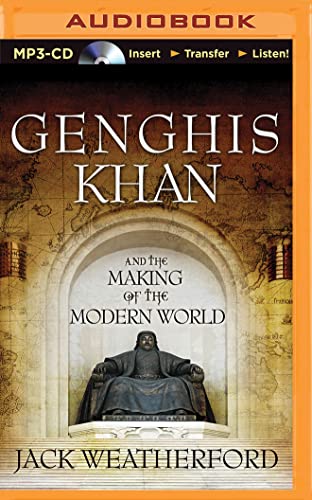

Genghis Khan and the Making of the Modern World [Jack Weatherford, Jonathan Davis] on desertcart.com. *FREE* shipping on qualifying offers. Genghis Khan and the Making of the Modern World Review: Revisionist History At Its Best - This is an enlightening book. Even though I like to consider myself knowledgeable about history, good historical literature routinely reminds me that I'm not really. Like most of us, I've allowed certain of my views to be shaped by stereotypes laid down in school and reinforced over the years by movies and other forms of popular entertainment. Judging from the story told in Professor Weatherford's book, perhaps no historical phenomenon has suffered from such degradation more than the Mongol Empire and the life of its founder Genghis Khan. I picked the book up because I had been searching for a biography of the famous conqueror. However, with only one primary source in existence giving any inside information about his origins, it quickly dawned on me that a comprehensive life story was neither available nor feasible. So I settled on this relatively short book, hoping to glean what I could. Weatherford recounts the standard fragmentary bio about as well as anyone might, but he alludes to the real purpose of his book in its subtitle. Genghis Kahn lived towards the end of what Westerners refer to as the Middle Ages. Weatherford suggests to us that this is no mere historical coincidence, and that Genghis Kahn and his descendents were key transitional figures who helped eradicate the parochial traditions of pre-modern society and lay the groundwork for our contemporary era. Despite the limitations in our knowledge of Genghis Kahn's early life, we know much more about what came later, for the simple reason that he overran so much of the world that he eventually forced his way into the attention of numerous chroniclers. Few of them had much good to say about him, but they did round out the history of his accomplishments. Stereotypes are rarely completely off-base, and the book does not minimize Genghis Kahn's penchant for unspeakable violence. Nazi militarists would later credit his cavalry tactics as the inspiration for their Blitzkrieg tank warfare that was to crush much of Europe seven centuries later. In the few short decades of his life, Genghis Kahn hammered together the largest contiguous empire in the history of the world, and he did it through the cold-blooded application of military power. However, what the popular picture leaves out is much about his motives and his methods, or the constructive side of his legacy. For it seems that Genghis Kahn was first and foremost a man of business. Far from being an end in itself for him, conquest was the means initially of acquiring the tribute necessary to finance the early expansion of his empire. Later, it gave him the range and leverage he needed to open up the world's trade routes, both among various regions of the Eastern world and, ultimately, between East and West. It was with this achievement that we see the real focus of his life and his contribution to our modern world. Genghis Kahn can be viewed as an early proponent of what we today have come to call "globalization". He understood both the military and economic power of technology, and he was adept at integrating the unique skills and resources of his subject peoples into his expanding realm. In this respect his empire was a progenitor of our modern multinational organizations. For all his military ferocity, Genghis Kahn was a surprisingly enlightened politician. He crushed opposing armies without mercy, but he protected and even nurtured civilian populations so long as they pledged loyalty and had useful knowledge and skills to contribute. He respected religion and, at a time when Christians were imposing a kind of religious totalitarianism over much of Europe, he was enforcing the freedom of worship within the regions he controlled. He established a pragmatic legal code and outlawed the more egregious forms of torture that were common in his day. He was meritocrat who accepted into his inner circle not only Mongol animists like himself, but Buddhists, Christians, Muslims, Jews, and anyone else deemed to have talents helpful in administering an empire of such unprecedented size and complexity. He viewed entrenched aristocracies as impediments to his work, and he routinely dismantled them in favor of new power structures more amenable to economic development. If the tales of his youth are to be believed, he enjoyed an intense albeit turbulent romance with his wife, and they remained loyal to one another throughout their lives. Author Jack Weatherford seems like an interesting fellow in his own right. He's an anthropology professor at a Midwestern college, but is no armchair academic. Apparently having a streak of Indiana Jones in him, Weatherford spent a great deal of time roaming the modern-day Mongolian steppes in an effort to overcome the dearth of primary sources for this study and to get closer to the spirit of his protagonist. His obvious affinity for Mongol culture imbues his writing with authenticity and a poetic quality that makes it a joy to read. This is an excellent book and I highly recommend it. Review: Terrific but polemic - I loved this book. It is a delightful read and very comprehensive. In fact, Genghis's life is covered in a little over half the book. The rest deals with the consequences. Other reviews have mentioned the inaccuracies, and sometimes the author is unclear as to whether he is recounting legend or fact. Much of the book about Genghis himself is based on The Secret History, a rare book, difficult to translate, and obviously written for political reasons. A problem I have is the tone of the book. While the author wants to correct the erroneous and confused image of Genghis, he tries too hard to "rehabilitate" the image. This is to some extent quite justified. But, I think the tone is almost like that of Genghis's PR agent. Of course it is a political year, so maybe I'm oversensitized. The author makes the very good point that the administration of Ghenghis, and to some extent his grandson Khubulai,employed many creative aspects from which we might learn. I'm puzzled, however, by the fact that Genghis was untutored and illiterate, typical of the Mongols, yet his administration required a lot of record keeping and arithmetical skills, the source of which is unclear. Moreover, the plethora of creative innovations would seem to have come from more than Genghis's experience and observation. Perhaps the author might have delved more deeply into where these factors came from. The author makes a very persuasive argument that much of the foundations of the Renaissance came not from Crusaders grabbing texts from the Holy Land but from their observations of, and interest in, the Mongols. There is a great section on the bubonic plague, supposedly originating in Southern China, infecting the world due to the trade routes and mail system developed by the Mongols. This development prostrated Europe and the Mongols as well, although several centuries before the Renaissance. One interesting note, not made by the author, is the impact of these reforms on modern China. For instance, we read elsewhere of the neighborhood and workplace "councils" prevalent to this day in China. An argument can be made that these reflect mongol traditions. Further, some of the current politburo struggles are reminiscent of those of the Mongols in a rather striking way. Those in the military might also benefit from reading the analysis of Genghis's military victories. He used the latest technologies, was highly unpredictable, focused on winning and winning only. Those enemies who gave up were treated well, those who didn't were disposed of. The Mongols succeeded in abolishing the assassins, appeared to pacify Afghanistan, and subdued a major portion of the Muslim world. Would that we were that successful. Although the purpose of war was often the booty, the book also shows the problems associated with an economy based on warfare, booty or none. Despite the author's academic background, the style is lucid and enjoyable. All in all, this is a very stimulating and enlightening book. I took one star away only because of the tone and what the author did not face, as described above.
| Best Sellers Rank | #3,194,246 in Books ( See Top 100 in Books ) #3 in Asian History (Books) #12,879 in Books on CD |
| Customer Reviews | 4.6 4.6 out of 5 stars (8,840) |
| Dimensions | 5.5 x 5.5 x 0.25 inches |
| Edition | Unabridged |
| ISBN-10 | 1491513705 |
| ISBN-13 | 978-1491513705 |
| Item Weight | 3.5 ounces |
| Language | English |
| Publication date | May 6, 2014 |
| Publisher | Brilliance Audio |
M**N
Revisionist History At Its Best
This is an enlightening book. Even though I like to consider myself knowledgeable about history, good historical literature routinely reminds me that I'm not really. Like most of us, I've allowed certain of my views to be shaped by stereotypes laid down in school and reinforced over the years by movies and other forms of popular entertainment. Judging from the story told in Professor Weatherford's book, perhaps no historical phenomenon has suffered from such degradation more than the Mongol Empire and the life of its founder Genghis Khan. I picked the book up because I had been searching for a biography of the famous conqueror. However, with only one primary source in existence giving any inside information about his origins, it quickly dawned on me that a comprehensive life story was neither available nor feasible. So I settled on this relatively short book, hoping to glean what I could. Weatherford recounts the standard fragmentary bio about as well as anyone might, but he alludes to the real purpose of his book in its subtitle. Genghis Kahn lived towards the end of what Westerners refer to as the Middle Ages. Weatherford suggests to us that this is no mere historical coincidence, and that Genghis Kahn and his descendents were key transitional figures who helped eradicate the parochial traditions of pre-modern society and lay the groundwork for our contemporary era. Despite the limitations in our knowledge of Genghis Kahn's early life, we know much more about what came later, for the simple reason that he overran so much of the world that he eventually forced his way into the attention of numerous chroniclers. Few of them had much good to say about him, but they did round out the history of his accomplishments. Stereotypes are rarely completely off-base, and the book does not minimize Genghis Kahn's penchant for unspeakable violence. Nazi militarists would later credit his cavalry tactics as the inspiration for their Blitzkrieg tank warfare that was to crush much of Europe seven centuries later. In the few short decades of his life, Genghis Kahn hammered together the largest contiguous empire in the history of the world, and he did it through the cold-blooded application of military power. However, what the popular picture leaves out is much about his motives and his methods, or the constructive side of his legacy. For it seems that Genghis Kahn was first and foremost a man of business. Far from being an end in itself for him, conquest was the means initially of acquiring the tribute necessary to finance the early expansion of his empire. Later, it gave him the range and leverage he needed to open up the world's trade routes, both among various regions of the Eastern world and, ultimately, between East and West. It was with this achievement that we see the real focus of his life and his contribution to our modern world. Genghis Kahn can be viewed as an early proponent of what we today have come to call "globalization". He understood both the military and economic power of technology, and he was adept at integrating the unique skills and resources of his subject peoples into his expanding realm. In this respect his empire was a progenitor of our modern multinational organizations. For all his military ferocity, Genghis Kahn was a surprisingly enlightened politician. He crushed opposing armies without mercy, but he protected and even nurtured civilian populations so long as they pledged loyalty and had useful knowledge and skills to contribute. He respected religion and, at a time when Christians were imposing a kind of religious totalitarianism over much of Europe, he was enforcing the freedom of worship within the regions he controlled. He established a pragmatic legal code and outlawed the more egregious forms of torture that were common in his day. He was meritocrat who accepted into his inner circle not only Mongol animists like himself, but Buddhists, Christians, Muslims, Jews, and anyone else deemed to have talents helpful in administering an empire of such unprecedented size and complexity. He viewed entrenched aristocracies as impediments to his work, and he routinely dismantled them in favor of new power structures more amenable to economic development. If the tales of his youth are to be believed, he enjoyed an intense albeit turbulent romance with his wife, and they remained loyal to one another throughout their lives. Author Jack Weatherford seems like an interesting fellow in his own right. He's an anthropology professor at a Midwestern college, but is no armchair academic. Apparently having a streak of Indiana Jones in him, Weatherford spent a great deal of time roaming the modern-day Mongolian steppes in an effort to overcome the dearth of primary sources for this study and to get closer to the spirit of his protagonist. His obvious affinity for Mongol culture imbues his writing with authenticity and a poetic quality that makes it a joy to read. This is an excellent book and I highly recommend it.
J**K
Terrific but polemic
I loved this book. It is a delightful read and very comprehensive. In fact, Genghis's life is covered in a little over half the book. The rest deals with the consequences. Other reviews have mentioned the inaccuracies, and sometimes the author is unclear as to whether he is recounting legend or fact. Much of the book about Genghis himself is based on The Secret History, a rare book, difficult to translate, and obviously written for political reasons. A problem I have is the tone of the book. While the author wants to correct the erroneous and confused image of Genghis, he tries too hard to "rehabilitate" the image. This is to some extent quite justified. But, I think the tone is almost like that of Genghis's PR agent. Of course it is a political year, so maybe I'm oversensitized. The author makes the very good point that the administration of Ghenghis, and to some extent his grandson Khubulai,employed many creative aspects from which we might learn. I'm puzzled, however, by the fact that Genghis was untutored and illiterate, typical of the Mongols, yet his administration required a lot of record keeping and arithmetical skills, the source of which is unclear. Moreover, the plethora of creative innovations would seem to have come from more than Genghis's experience and observation. Perhaps the author might have delved more deeply into where these factors came from. The author makes a very persuasive argument that much of the foundations of the Renaissance came not from Crusaders grabbing texts from the Holy Land but from their observations of, and interest in, the Mongols. There is a great section on the bubonic plague, supposedly originating in Southern China, infecting the world due to the trade routes and mail system developed by the Mongols. This development prostrated Europe and the Mongols as well, although several centuries before the Renaissance. One interesting note, not made by the author, is the impact of these reforms on modern China. For instance, we read elsewhere of the neighborhood and workplace "councils" prevalent to this day in China. An argument can be made that these reflect mongol traditions. Further, some of the current politburo struggles are reminiscent of those of the Mongols in a rather striking way. Those in the military might also benefit from reading the analysis of Genghis's military victories. He used the latest technologies, was highly unpredictable, focused on winning and winning only. Those enemies who gave up were treated well, those who didn't were disposed of. The Mongols succeeded in abolishing the assassins, appeared to pacify Afghanistan, and subdued a major portion of the Muslim world. Would that we were that successful. Although the purpose of war was often the booty, the book also shows the problems associated with an economy based on warfare, booty or none. Despite the author's academic background, the style is lucid and enjoyable. All in all, this is a very stimulating and enlightening book. I took one star away only because of the tone and what the author did not face, as described above.
B**5
Per approfondire un tempo, un mondo davvero poco studiati
グ**ン
Must read if you want to learn about the nomadic life
A**A
it arrived fast, i gifted it.
S**N
Loved this book, Accurate information about Mongol empire and Genghis Khan
9**T
If you are just beginning to research the Mongol Empire, this is an excellent book to begin with. Also if you are just looking for a brief overview, this book would also be fit for purpose. This is and easy read without weighty voluminous detail and does not pretend to be a textbook, but a short informative introduction. The serious study of Mongol history has been hampered by centuries of secrecy by both the custodian, the Qing Dynasty and the repressive Soviet Union. The translation of the Secret History of the Mongols was first begun in the early 1980's by an Australian/Italian historian of noble Tatar (Mongol) descent, Igor de Rachewiltz. The torch was taken up by others following the collapse of the Soviet Union and the freedom of Soviet controlled Mongolia. However, the over a million Mongols remain under the repressive hand of China in an area of about half of the Mongolian Republic, called Inner Mongolia on the the republic's southern border. In full disclosure, in 1984, as an undergraduate, I wrote and extensive research paper titled, "The Sino-Mongolian Impact on Europe." The impact of the Mongols on world history cannot be underestimated. In the late Medieval Era, the Mongols created a superhighway into Europe that led to an explosion of knowledge and technological advancement. All the brilliance of science and technology in the Orient, particularly China, streamed into Europe leading to the Medieval evolving into the Renaissance and eventually the Agrarian and Industrial Revolutions. At the point of first contact in the mid-Thirteenth Century Europe was a millennium behind Asia in technology, art and science. Within less than two hundred years that gap had been closed and the sky was not even the limit. Rather than the blood thirsty and cruel invaders that later ignorant people portrayed them to be, they were brilliant administrators and free thinkers ended religious wars and banditry. In so doing, they intentionally and deliberately facilitated the free flow of trade and ideas from Asia to Europe. It was the restriction of this trade by the rising Ottoman Empire that led to the Age of Discovery. Europeans seeking direct access to China and India drove the creation of the modern world. For further reading, have a look at the work begun by Professor Joseph Needham of Cambridge, Science and Civilisation in China that is an ongoing work of 7 volumes in a current set 27 books. While the prosperity of the modern world has allowed space for new nihilistic and destructive voices decrying this advance, they, themselves, would not exist, nor be able to communicate with the books, technology and free trade were it not for the Mongol Empire.
Trustpilot
1 month ago
3 weeks ago