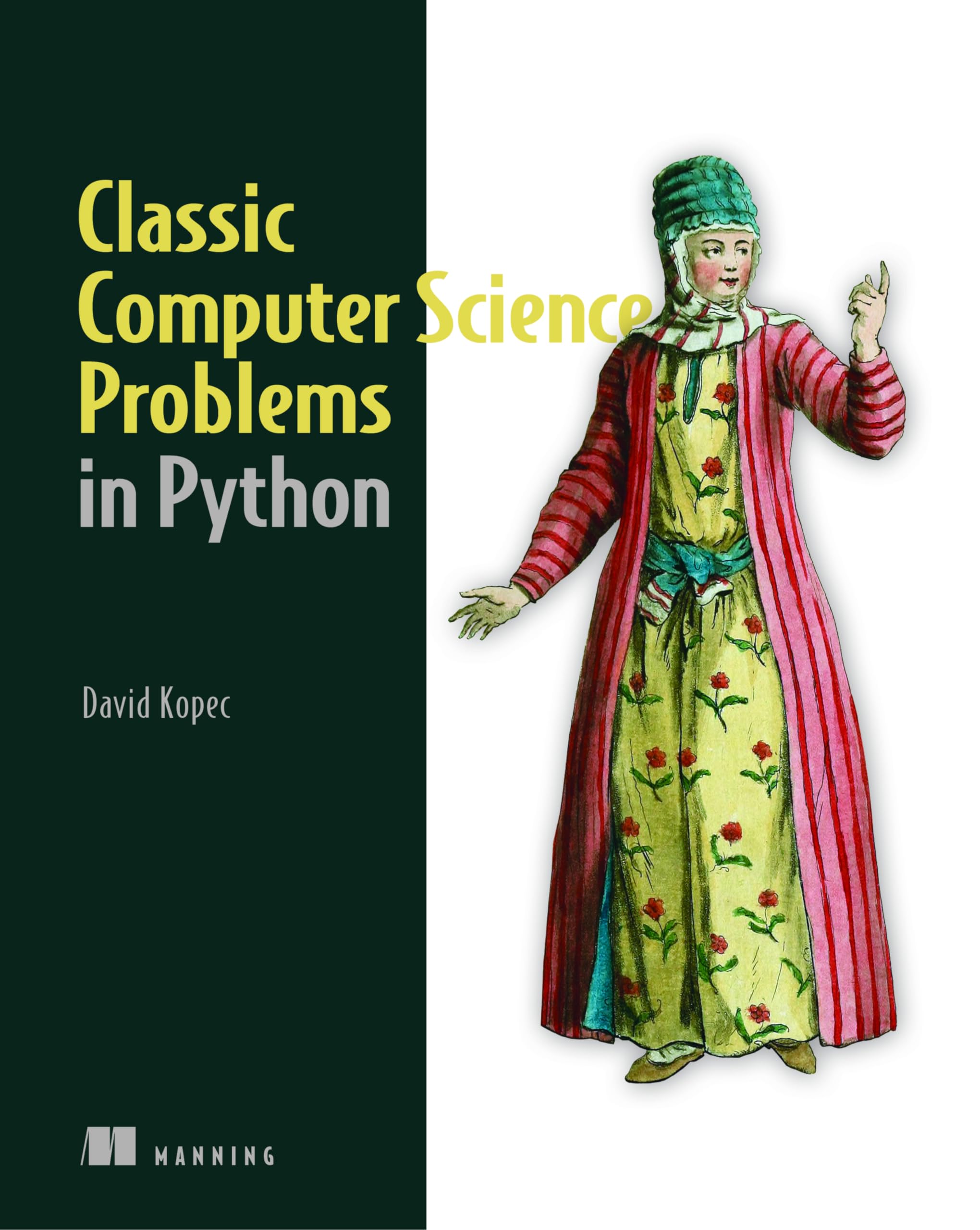
Classic Computer Science Problems in Python : Kopec, David: desertcart.in: Books Review: If you've already done a decent amount of programming in at least two other languages (including at least one OO), this is a great book to learn about python from. It does not bother with the simple things that you can look up online in two seconds (flow control syntax, defining a simple function, etc.) or OOP concepts. Instead it is a very well chosen set of, as the title implies, classic algorithms with broad use value: K-means clustering, graph searching, constraint-satisfaction problems, even neural network basics. Each of these forms a chapter with a simple, comprehensible generic implementation, presented piecemeal in a narrative and then applied to a handful of different concrete problems. I'd seen most of these techniques before, but I wish my original introduction to them had been this succinct and balanced. Along the way of various features and conventions of python are introduced in a natural way. The author also uses the relatively new (not strictly enforced) typing annotations, which I appreciated as a fan of strong typing. Again, though, if you are out to learn programming with python, this probably is not the book for you. But if you already understand OOP well and want something interesting to survey a new language with, this is a lot of fun. Review: This book is great for semi-experienced python users. Every chapter introduces several new pythonic concepts and provides a very nice generic framework for trying out the algorithms described. It is the kind of book where you'd get the most out of it when you work through it.
| Best Sellers Rank | #493,437 in Books ( See Top 100 in Books ) #6,583 in Computer Science Textbooks |
| Country of Origin | USA |
| Customer Reviews | 4.4 4.4 out of 5 stars (147) |
| Dimensions | 18.75 x 1.27 x 23.5 cm |
| ISBN-10 | 1617295981 |
| ISBN-13 | 978-1617295980 |
| Item Weight | 381 g |
| Language | English |
| Paperback | 224 pages |
| Publisher | Manning Publications; First Edition (15 March 2019); Pearson Benelux BV; [email protected] |
M**K
If you've already done a decent amount of programming in at least two other languages (including at least one OO), this is a great book to learn about python from. It does not bother with the simple things that you can look up online in two seconds (flow control syntax, defining a simple function, etc.) or OOP concepts. Instead it is a very well chosen set of, as the title implies, classic algorithms with broad use value: K-means clustering, graph searching, constraint-satisfaction problems, even neural network basics. Each of these forms a chapter with a simple, comprehensible generic implementation, presented piecemeal in a narrative and then applied to a handful of different concrete problems. I'd seen most of these techniques before, but I wish my original introduction to them had been this succinct and balanced. Along the way of various features and conventions of python are introduced in a natural way. The author also uses the relatively new (not strictly enforced) typing annotations, which I appreciated as a fan of strong typing. Again, though, if you are out to learn programming with python, this probably is not the book for you. But if you already understand OOP well and want something interesting to survey a new language with, this is a lot of fun.
A**R
This book is great for semi-experienced python users. Every chapter introduces several new pythonic concepts and provides a very nice generic framework for trying out the algorithms described. It is the kind of book where you'd get the most out of it when you work through it.
P**P
Best book
M**S
I am a season programer and really enjoyed this book. Found examples to be quite complete. It has helped me improve my Python skills.
J**Y
This is a good book, but I don't think it serves a very wide audience well. It covers some of the most famous and popular algorithms out there – but it moves so fast and goes into so little depth that I can't recommend it to someone junior looking to learn these topics (which seems to be the target audience). I think anyone who already has a handle on all these algorithms, and just wants to learn efficient ways to write them in Python, will be happy with this book. But if you don't know these algos, and/or you're not already very confident in Python, this book is equally as confusing as educational. I know Python well, and I know most of the algos in this book already, so for me those were easy to read over and the Python code made perfect sense. The few that I didn't already know, however, left me confused and frustrated, because the explanations just didn't go into enough granular detail (about the algo logic nor the python implementation) or give enough different examples for me to really make sense of them from reading alone (which a well written book does offer). Final word: If you already know Python and you just want a reference implementation of algos you already firmly understand, this book is a walk in the park. For anyone else there is certainly lots of value in this book, but it may also leave you with as many questions as answers by the final page.
Trustpilot
3 weeks ago
2 days ago