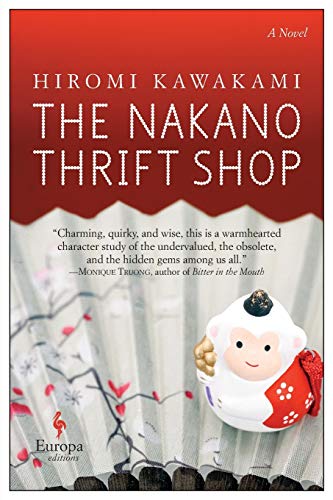
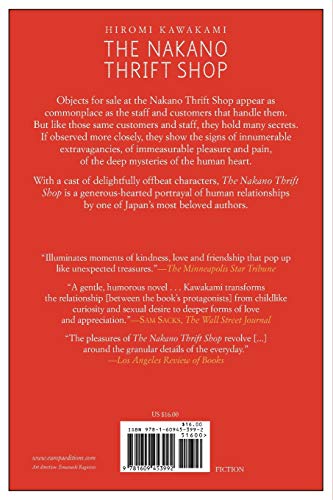
Europa Editions The Nakano Thrift Shop
T**J
How this is rated anything above a solid average is beyond me
Let me make a few things clear in this review - I tend to love Japanese fiction, and I think Strange Weather in Tokyo is one of the best novels I have read in a very long time. This however fell short of the mark for me - for a number of reasons I outline below.1. When you are going to write a novel which isn't rich in plot, and focuses around essentially one thrift shop you better be very good at bringing the shop to life. I want to smell the dust as I read, feel the objects in my hands. This is one area where it fell a little short - the description of the surroundings were nowhere near rich enough, which contributed to the boredom I felt during this book.2. I am not sure the translation is that good. There are a number of places where there are inconsistent uses of quotation marks, with a single ' not the usual " used when one person is speaking, but not when the other person is leaving you to work out what's conversation and what is not.3. It is interested seeing all of the social dynamics, sort of, but the characters are not even close to being developed enough. I am used to the character development of someone like Murakami, or Updike or Tsukiko in Strange Weather in Tokyo, but I come away from this book without feeling I really "know" any of the characters.4. The narrative is so choppy. I don't mind a choppy narrative when the author ties it all together in a clever way (think Hard Boiled Wonderland and the End of the World) but this is just plain choppy. Contributes to making it very hard to read.I give the book three stars because at times it does offer an interesting look in to Japanese life, but after strange weather in Tokyo you are sure to be left disappointing - an average 3/5 from me, for a book which just never got going.
K**R
Another gem by Hiromi Kawakami
I guess there is the temptation to somehow label Kawakami's books 'love stories'. I don't think they are. They are more narratives about how the characters time and again struggle to bridge those vertiginous distances that sometimes exist between human beings, whether that is mother-daughter, brother-sister, teacher-student, lovers, friends or others. They are also about the distances that not just others, but we ourselves, create towards them and build upon.Without going into the plot details, for the whole length of the book we are most of the time in the thrift shop of the title, run by Mr Nakano. Never boring, never slow, never repetitive. More difficult to achieve than it seems. Two of his employees are young people (one of which is our female narrator) and the last central character is Mr Nakano' sister. All the little wonderful, superbly simple yet deeply complex tales of people and their mysteries will spin out of this place.I don't remember now that much about this title, but Ernst Lubitsch's film "The Shop around the Corner" suddenly came back to me when I was reading "The Nakano Thrift Shop". Something about the humour, the compassion and the stubbornness of characters trying to find and reach each other. In the case of this book, a thrift shop is such a perfect set-up for the unfolding of story. There is not even the need to move the characters out of the receptacle of the shop. Objects arrive to the shop, and then they leave the shop. People -with their own private stories- bring or buy those objects. Objects, ultimately, cause story, push story, motivate story. They arrive to Mr Nakano's shop full of little narratives, carrying stories within them and intersecting in strange ways. They are a bit like the silent characters in the book.I can't stop imagining Mr Nakano as a slightly younger Hayao Miyazaki, wearing his apron, full of quirk and mischievious oddities, devilish. So refreshing to see a writer create such individual and inspired male middle-age, unconventional characters. As to Hitomi, our main character and narrator, everyone that crosses her path in the little microcosmos of the thrift shop remains unreadable, inscrutable and un-understantable to her as if they kept on going in and out of focus. In other instances, Mr Nakano will express a similar impossibility to understand his lover and this theme runs through the story and through many characters.Beautiful simplicity and a lot more than quirky charm. Kawakami is an exquisite observer of human behaviour and the delightful dance of approximations between people, then the restored distances, as all closeness and intimacy is essentially ephemeral and uncertain.Only at the very end did I fear a slight danger of sentimentality, but no, the author managed to rein in just at the right time and I am so tempted to call Hiromi Kawakami a genius.
A**R
Mundane & forgettable
Overall, it's rather mundane, with chapters based around not especially exciting incidents that happen in a thrift shop in Tokyo. It's the kind of story that I imagine as appearing as a serial in a woman's magazine. The characters are not especially deep or memorable. While I'm interested in Japanese culture, I haven't yet worked out why this author is so popular.
A**1
I thought the ending was sweet
Sadly, I found this book quite boring and it took an age to finish because I would fall asleep quite quickly during it. I wanted to enjoy it - Japan and thrift shops are two of my interests - but it didn't jog along like western novels and I found the punctuation quite hard work at times. All that said, I thought the ending was rather sweet.
M**Y
Funny, Thoughtful and Touching
Hitomi, the book's narrator and employee at Nakano's thrift shop, tells the story of her life, those of her co workers and some of the visitors to the shop, through the lens of some of the items in the shop. Each chapter focuses on an object and a relationship brought into the foreground of the narrative by Hitomi. The stories interlock and weave together to create a sense of this world slightly to the edge of the centre. Funny, thoughtful and touching.
Trustpilot
2 weeks ago
3 days ago