
DOWNLOAD THE APP


Customer Services
Copyright © 2025 Desertcart Holdings Limited
DOWNLOAD THE APP

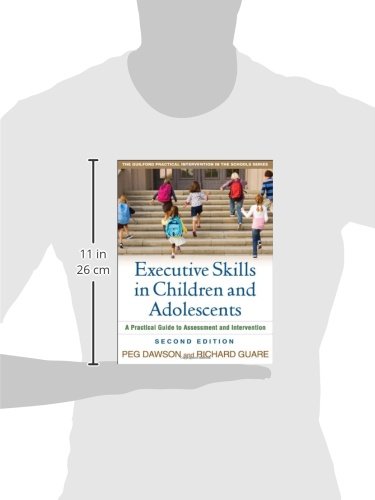
Executive Skills in Children and Adolescents, Second Edition: A Practical Guide to Assessment and Intervention (The Guilford Practical Intervention in the Schools Series): 9781606235713: Medicine & Health Science Books @ desertcart.com Review: A must for today's differentiated classroom - Entering the phrase "executive functioning" on Google resulted in 2,780,000 hits today. Any phrase with that many hits has to be included when addressing student difficulty in the classroom! The authors are very clear in stating that executive skills are not addressed in the traditional intelligence/achievement test batteries. This cluster of skills include planning/directing behavior, working memory, sustained attention, and goal-directed persistence to name only a few. Dawson and Guare include chapters on the neurological working of the brain, methods of assessing executive functioning, linking assessment to intervention (both with individual students and with a class), coaching, implementing strategies within an RTI framework, and diagnosed populations. The chapter on transitions, either between classes or schools, is also very useful. The concern in this book is on addressing symptoms/behaviors which may be interfering with a student's success. While useful to a wide population of adults wishing to implement a positive change in a student, it must be remembered that behavioral checklists provide only one source of information for a very complex set of skills. The use of published, standardized behavior checklists are discussed as an adjunct to the material covered in this book. This revised book will prove to be a very useful reference for those responsible for recommending and/or implementing strategies for struggling students. Review: Very useful resource - This is a very useful resource for working with parents, teachers and students. It helps to identify students' STRENGTHS as well as weaknesses. When a student and I go through the questionnaire and then I say, "It looks like you are really good at..." the student is surprised and is much more accepting of, "And it looks like you could use some help with..." The book also offers specific ways to help students develop some of the skills in which they may be weaker. This is my favorite book for working with students who haven't been very successful at school.
| ASIN | 1606235710 |
| Best Sellers Rank | #789,487 in Books ( See Top 100 in Books ) #147 in Child Psychiatry #822 in Medical Child Psychology #1,146 in Popular Child Psychology |
| Customer Reviews | 4.6 4.6 out of 5 stars (140) |
| Dimensions | 8.25 x 0.5 x 10.5 inches |
| Edition | 2nd |
| ISBN-10 | 9781606235713 |
| ISBN-13 | 978-1606235713 |
| Item Weight | 1.1 pounds |
| Language | English |
| Print length | 224 pages |
| Publication date | February 17, 2010 |
| Publisher | The Guilford Press |
K**K
A must for today's differentiated classroom
Entering the phrase "executive functioning" on Google resulted in 2,780,000 hits today. Any phrase with that many hits has to be included when addressing student difficulty in the classroom! The authors are very clear in stating that executive skills are not addressed in the traditional intelligence/achievement test batteries. This cluster of skills include planning/directing behavior, working memory, sustained attention, and goal-directed persistence to name only a few. Dawson and Guare include chapters on the neurological working of the brain, methods of assessing executive functioning, linking assessment to intervention (both with individual students and with a class), coaching, implementing strategies within an RTI framework, and diagnosed populations. The chapter on transitions, either between classes or schools, is also very useful. The concern in this book is on addressing symptoms/behaviors which may be interfering with a student's success. While useful to a wide population of adults wishing to implement a positive change in a student, it must be remembered that behavioral checklists provide only one source of information for a very complex set of skills. The use of published, standardized behavior checklists are discussed as an adjunct to the material covered in this book. This revised book will prove to be a very useful reference for those responsible for recommending and/or implementing strategies for struggling students.
J**E
Very useful resource
This is a very useful resource for working with parents, teachers and students. It helps to identify students' STRENGTHS as well as weaknesses. When a student and I go through the questionnaire and then I say, "It looks like you are really good at..." the student is surprised and is much more accepting of, "And it looks like you could use some help with..." The book also offers specific ways to help students develop some of the skills in which they may be weaker. This is my favorite book for working with students who haven't been very successful at school.
J**.
for educators, counselors and parents
Was suggested to us for at home. Is really more geared toward schools, but so many of the things can help parents at home. This is the best written suggestions I have seen. If you don't have executive skill problems, it is difficult to know how to help those who do. And this takes a more step by step approach. This was great! Educators and counselors and parents all should have a copy.
A**R
A must for teachers of ADHD, ASD or others who are organizationally challenged
This is well thought out, easy to use and the reproducable activities in the back of the book cover about every scenario you can think of - and some you didn't. The sections to survey student, an important factor in helping students help themselves, is something frequently overlooked. Without reading the whole book - I was using some of the materials within 10 minutes of opening the box. If you are teacher or parent of the disorganized you will find ways to help support your student in their education.
A**R
Understanding what you see
This book has helped on what to look for in my students and detailed ideas on how to help my students exercise and grow their Executive Function Skills.
A**Y
Thought provoking
This a read suited to parents and teachers although I was approaching it from the perspective of a person interested in the psychology of organizational behavior . It is thought provoking and may have initiated a hypothesis for a research project .
S**T
Excellent book for Professionals and Parents.
I really liked the way this book is organized and also the content. I saved some money by buying it from Amazon vs at the workshop I attended on Psychoneurology. The book has helped me in my work as a School Psychologist and also in working as a Clinical Social Worker. I met the author and she is excellent to listen to as well.
N**C
This book can make a difference for the students you teach!
This is an excellent guide and should be read by all teachers. Executive Function skills are mandatory for success in school and they have not had much attention until fairly recently. It is critical that more professionals pay attention to the information in this book.
J**A
Rather than trying to labeling a kid as having a particular kind of LD, ADHD, or being "behavioral," this books claims that we should be looking for challenges in executive functioning as a source of that kid's difficulties. These are the executive skills identified here: 1. Response inhibition (answering questions without thinking, tries to begin without listening to all the instructions, etc.) 2. Working memory (typically associated with the ADHD diagnosis, asks to have questions or instructions repeated, pauses while working and needs to be prompted to get back to work, remembers the last piece of information but loses information that came early in a sequence) 3, Emotional control (becomes visibly upset or easily frustrated when tasks or items become challenging) 4. Sustained attention (easily distracted) 5. Task initiation (needs reminders to get started) 6. Planning/prioritization (can't complete tasks in order of priority of importance) 7. Organization (messy, can't produce organized piece of writing) 8. Time management (difficulty completing tasks on time, or estimating how long will an activity take) 9. Goal-directed persistence (doesn't stick with challenging tasks) 10. Flexibility (easily upset by changes in plans, excessively "rule-bound") 11. Metacognition (doesn't check work, asks for help rather than trying to solve on his/her own, doesn't like activities that require problem-solving). Every single person has strengths and challenges in the above categories, which --to me-- removes a lot of stigma from LDs, and allows a useful lense through which to approach the more challenged of our learners. The book goes on to offer assessment strategies for the above skills, as well as suggestions on how to help people compensate for, or maybe even, overcome, some of them. It is well-written, and definitely a practical and useful resource for anybody parenting or educating LD kids.
C**N
Estou gostando bastante do livro! A pesquisa feita pelos autores que colheram excelentes resultados têm contribuído com muita relevância para a minha pesquisa! Agradeço ao site Amazon, porque o livro chegou muito rápido e com isso tenho conseguido cumprir com os meu prazos! Foi a primeira vez que eu comprei pelo site e estou super satisfeita! Agora aguardando outro livro que já está a caminho!
M**T
Some good ideas - directed at American market
W**L
Interesting book that does what it says in the title. Great checklist and intervention plan included - well worth buying for anyone interested in this areas (educational psychologists, teachers, SENCOs, TAs, key workers, etc)
K**E
This book is a great support to families in better understanding and supporting the development of executive functioning skills. Many of the forms included will allow for immediate intervention. Both parents and educators will find it useful!
Trustpilot
3 weeks ago
1 month ago