We remain fully operational. Our teams are working around the clock to ensure your deliveries continue safely.

DOWNLOAD THE APP


Customer Services
Copyright © 2025 Desertcart Holdings Limited
DOWNLOAD THE APP

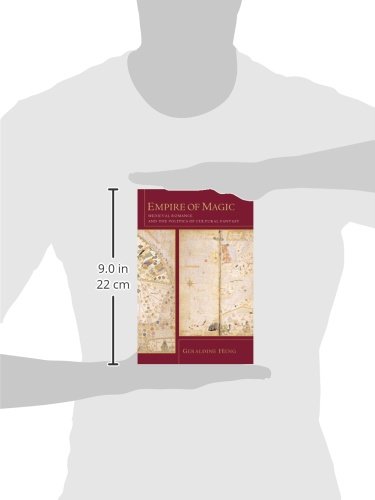
Full description not available
J**D
This is definitely the best book about medieval romance you will ever read
Have you ever wondered where the legend of King Arthur originally came from? Why, after a thousand years, is this romance so popular? With insights on subjects as diverse as King Arthur, Chaucer, and 9/11; Geraldine Heng's book "Empire of Magic" is an absolute tour de force that illuminates the secret history of medieval romance. Indeed, "Empire of Magic" is so shocking and engaging that it almost reads like a detective novel of sorts. Heng shows us the hidden (and sometimes horrifying) connections between medieval literature and medieval history in a way that is both unsettling and unforgettable. After all, who but a great detective could have uncovered links between the legend of King Arthur and acts of cannibalism committed by Christians during the first Crusade?This book is essential reading for anyone interested in literature, history, or the Middle Ages, and is an incredible treat for anyone who likes intellectually stimulating reading of any variety. You will be amazed that reading about literature can be this mind-bending and fun.Pick up this book. You won't regret it.
M**L
Unpersuasive and jargon-filled
Garden variety academic nonsense. Take a few texts and shove them through the deconstructive meat grinder so you get the entirely predictable conclusions you want. In this case: medieval romance is an ideological disguise for Europe's guilt over its invasion and conquest of the Middle East. How do we know this? Because there are some accounts of the First Crusade that depict cannibalism, and later in Geoffrey of Monmouth's history there is a chapter in which King Arthur fights a giant that eats people. If you find this persuasive, and you like all the usual academic affectations that make the prose miserable to wade through, you'll like this book.There are so many studies of medieval romance that are far, far better. Helen Cooper's The English Romance in Time, for instance, is witty, erudite, and analytically sound.
A**R
Sharp, Precise, Exhaustive, Brilliant, and somehow despite all of that, pleasantly coherent and interesting
If you have any interest whatsoever in Medieval Romance then this is a book for you. Whether your interests are historical, cultural, or structural this book has a theory to match. I will caution this book has little to do with Chaucer or other prototypical Medieval standards, but that is precisely why I found the read so refreshing. In this book you will find a stunning and coherent analysis of five different Romances teachers too often place on the additional course reading lists, if at all, and it is exactly this newness of study that I must encourage you to delve into.Empire of Magic explores these texts with the passion of a true enthusiast, and it works through the pieces with the thoroughness of a learned, careful mind. The analysis builds a multitude of spiraling theories and possibilities ranging from mental warfare cannibalism to the impact cannibalism could've made on race relations to how race relations might have influenced the writer to dream up acts of cannibalism to write about. BUT hey! If cannibalism doesn't do it for you then you might enjoy a different analysis of King Richard the Lion Heart (and cannibal in some romances...read the book to find out!) such as why he was such a popular King despite being away from England for almost the entirety of his rule? And why did his contemporaries like him so much despite the almost ruin of the country because of his constant warring? My favorite section takes a careful look at Mandeville Travels, and the question is raised as to whether Sir John actually ever traveled any further than his local library. Again, I encourage you to read the book to find out.Overall, what makes this book brilliant, other than the nice size and weight which could work well on a bookshelf, nightstand, backpack, or coffee table, or the print size which is also nice because its the kind where it isn't too small that your eyes hurt or too large where your friends make fun of you because it looks like a 2nd grade reader, and other than the fact that it's a steal as a genius theoretical book divided into five sections for your convenience for only $25, is that the book contains valuable currency. Not just the mental currency that colleges everywhere are getting by on by charging high prices, but the currency of being current despite the book being about Medieval texts. The issues addressed in this book are issues that we face today in society all around us, and the theories this book offers about Medieval societies and their symbiotic relationships to their texts of information and entertainment line up to our society with chilling resonances. This book, with careful research, inspiration, and study, makes these Medieval romances as relevant and debatable as the movie coming out this Friday, and you, with an easy click of a button, can bring it all to your place of residence, which I highly recommend.
H**M
Twisted Eurocentrism.
There is little disputing that "romances" of all kinds are born from clash of cultures and are shaped by political and social agendas of the day. The question is how different, or if at all, the medieval European romances were compared to their counterparts in Sassanid Persia, Abbasid Arabia, or Medieval China from Tang to early Ming, or for that matter, the ancient eras of many civilizations. I'm hardly an expert on comparative mythologies and romances, but even I've come across enough romances from these cultures to be aware that many of the themes Heng raises are in fact far older and far more universal: the same themes, if only in slightly different guises, show up everywhere. They are hardly a European thing. I suspect that many authors who assert such claims do so because they lack familiarity with other cultures and their stories, and when they see linkage between the stories that they know--invariably the Western ones--and flaws of the modern West, assume fallaciously that the two are uniquely linked. This is a peculiar version of Eurcentrism that that a cynical historian of early modern history well-known for his biting humor joked about: Westerners think the West is uniquely evil because they are familiar only with the follies of the West. The more things change...PS. The title probably should have been "Twisted Anglocentrism," rather than Eurocentrism at large.
Trustpilot
1 month ago
1 day ago