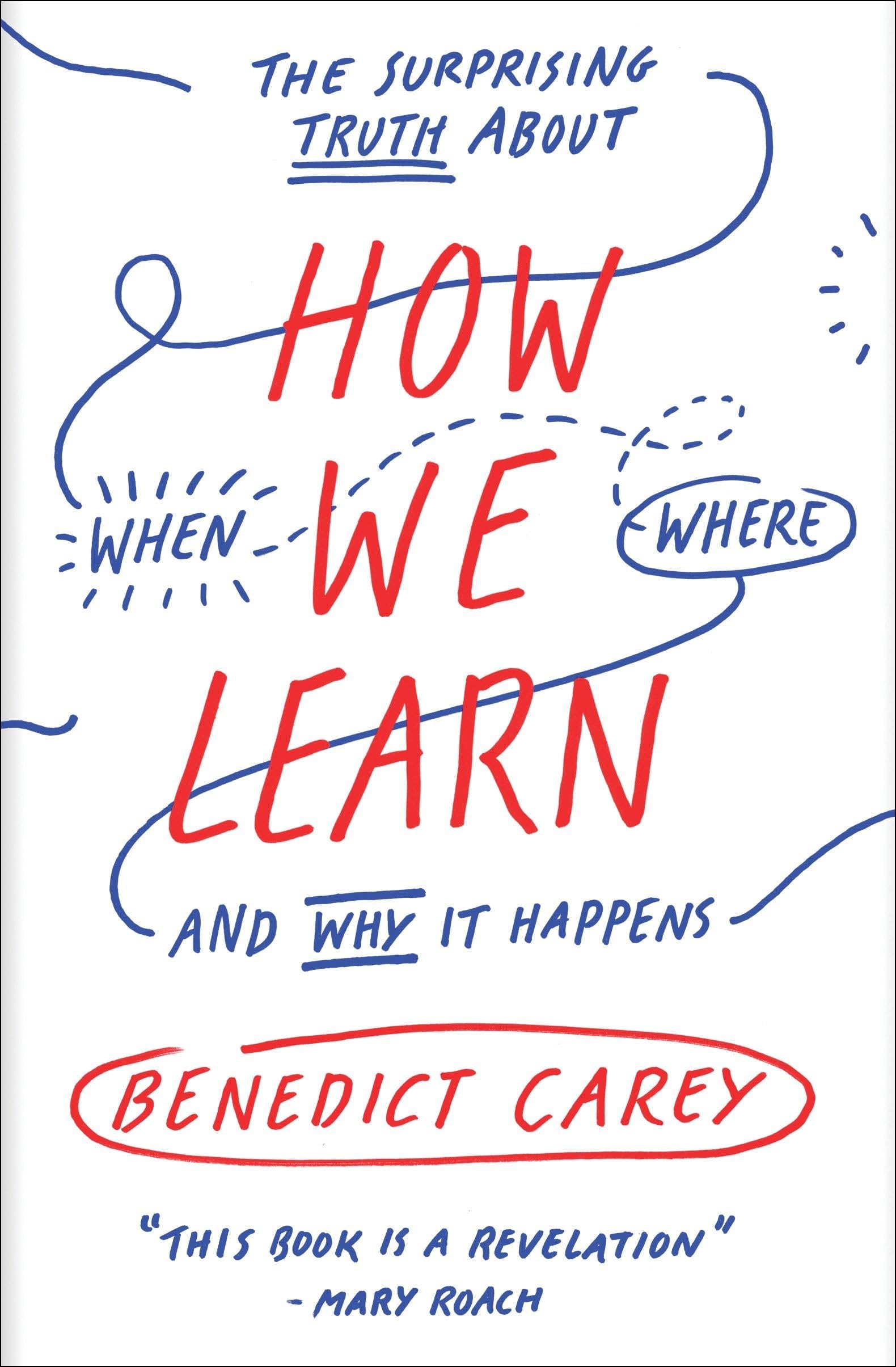

How We Learn: The Surprising Truth About When, Where, and Why It Happens [Carey, Benedict] on desertcart.com. *FREE* shipping on qualifying offers. How We Learn: The Surprising Truth About When, Where, and Why It Happens Review: The book is packed with fascinating research studies. - “The treasure at the end of this rainbow is not necessarily ‘brilliance.’ Brilliance is a fine aspiration, and Godspeed to those who have the genes, drive, luck, and connections to win that lottery. But shooting for a goal so vague puts a person at risk of worshipping an ideal—and missing the target. No, this book is about something that is, at once, more humble and more grand: How to integrate the exotica of new subjects into daily life, in a way that makes them seep under our skin. How to make learning more a part of living and less an isolated chore. We will mine the latest science to unearth the tools necessary to pull this off, and to do so without feeling buried or oppressed. And we will show that some of what we’ve been taught to think of as our worst enemies—laziness, ignorance, distraction— can also work in our favor.” ~ Benedict Carey from How We Learn Benedict Carey is a science writer for The New York Times. This book is his exploration of what the latest research says about, you guessed it, How We Learn. I read it as part of my preparation for Learning 101. Check out our Notes on Make It Stick (written by a story teller + two leading cognitive scientists focused on the science of learning) and A Mind for Numbers (written by a math teacher who taught one of the most popular classes in history) for more learning goodness. I’m excited to share some of my favorite Big Ideas: 1. Distributed Learning - Think: Watering your lawn. 2. Enemy #1 for Learning - =Fluency illusion. 3. Can You Teach It? - Powerful way to learn. 4. Mix It Up - To strengthen the learning. 5. Sleep + Naps - = Learning with your eyes closed. Here’s to optimizing how we learn as we actualize our potential! More goodness— including PhilosophersNotes on 300+ books in our *OPTIMIZE* membership program. Find out more at brianjohnson . me. Review: All the concepts are easily understood and very interesting - This book is well written and engaging. All the concepts are easily understood and very interesting. Carry is a wonderful writer and we're very lucky to have all this fascinating and valuable information distilled in a form that all can appreciate. The book motivated me to try the different strategies he describes. I would recommend this book especially to new students entering college. This is the one thing that will motivate you to focus and will boost your confidence. Give it a try.


| Best Sellers Rank | #62,878 in Books ( See Top 100 in Books ) #43 in Memory Improvement Self-Help #46 in Educational Psychology (Books) #130 in Cognitive Psychology (Books) |
| Customer Reviews | 4.4 4.4 out of 5 stars (1,467) |
| Dimensions | 5.5 x 0.6 x 8.3 inches |
| Edition | Reprint |
| ISBN-10 | 0812984293 |
| ISBN-13 | 978-0812984293 |
| Item Weight | 2.31 pounds |
| Language | English |
| Print length | 272 pages |
| Publication date | June 9, 2015 |
| Publisher | Random House Trade Paperbacks |
B**C
The book is packed with fascinating research studies.
“The treasure at the end of this rainbow is not necessarily ‘brilliance.’ Brilliance is a fine aspiration, and Godspeed to those who have the genes, drive, luck, and connections to win that lottery. But shooting for a goal so vague puts a person at risk of worshipping an ideal—and missing the target. No, this book is about something that is, at once, more humble and more grand: How to integrate the exotica of new subjects into daily life, in a way that makes them seep under our skin. How to make learning more a part of living and less an isolated chore. We will mine the latest science to unearth the tools necessary to pull this off, and to do so without feeling buried or oppressed. And we will show that some of what we’ve been taught to think of as our worst enemies—laziness, ignorance, distraction— can also work in our favor.” ~ Benedict Carey from How We Learn Benedict Carey is a science writer for The New York Times. This book is his exploration of what the latest research says about, you guessed it, How We Learn. I read it as part of my preparation for Learning 101. Check out our Notes on Make It Stick (written by a story teller + two leading cognitive scientists focused on the science of learning) and A Mind for Numbers (written by a math teacher who taught one of the most popular classes in history) for more learning goodness. I’m excited to share some of my favorite Big Ideas: 1. Distributed Learning - Think: Watering your lawn. 2. Enemy #1 for Learning - =Fluency illusion. 3. Can You Teach It? - Powerful way to learn. 4. Mix It Up - To strengthen the learning. 5. Sleep + Naps - = Learning with your eyes closed. Here’s to optimizing how we learn as we actualize our potential! More goodness— including PhilosophersNotes on 300+ books in our *OPTIMIZE* membership program. Find out more at brianjohnson . me.
D**A
All the concepts are easily understood and very interesting
This book is well written and engaging. All the concepts are easily understood and very interesting. Carry is a wonderful writer and we're very lucky to have all this fascinating and valuable information distilled in a form that all can appreciate. The book motivated me to try the different strategies he describes. I would recommend this book especially to new students entering college. This is the one thing that will motivate you to focus and will boost your confidence. Give it a try.
D**R
Revolutionary ...
Not necessarily a book for the casual reader, but this book is a wonderful tome of information on the latest research and findings in learning theory and cognitive psychology. In concert with Scott Barry Kaufman's book, "Ungifted," students of teaching and learning will have a great foundation of knowledge to improve their practice. This is the easier of the two books to read, in my opinion. So I would start with this book. But I think a good companion book would be the aforementioned "Ungifted." This is the kind of book educators and all those who claim to care about education (re: Bill Gates, Michelle Rhee, Jeb Bush, Arne Duncan, et al.) should be reading and using as a basis of their reform agenda. Would they, we would not be talking about standardized testing, Teach For America, and Common Core State Standards and curricula. Rather, we would be talking about meaningful teacher preparation and ongoing professional training. We would be improving schools from within the profession (ignoring all the pretend experts who propose big, expensive, one size fits all solutions) with teacher experts sharing their insights, knowledge and new paradigms for teaching and learning. Hopefully this book will be required reading in teacher preparation classes, and in schools that are searching for research-based ideas for how to improve learning in classrooms. Well done, Mr. Carey. Hopefully a much needed revolution is on the way, and you are part of the reason.
R**N
Great book on learning science
This is one of the best books I've read in a long time. The book has a very pleasant to read style, and there is absolutely no filler material. The book was interesting from the first to the last page. The writer discusses several topics related to learning performance, by guiding you through the research done on these topics. Starting from 1900, the advances in learning science are discussed, including a lot of the difficulties scientist had with their reasearch. Other books I've read regarding learning cover mostly general information, and with a little common sense you would have reached the same conclusions. This book disputes some of these 'known methods', and actually provides the research instead of making empty claims. But the writer also has a good feeling for the limitations of the research, and doens't draw incorrect conclusions from it. All in all I think this is a great book if you are interested in the way we learn. This books isn't about the quick tips your teacher gave you in high school, but gives you a deeper understanding about the mechanism behind learning, which will ultimately, in my opinion, be of much greater value.
E**S
Insightful Popular Account of Recent Studies into Cognition
Four stars and not five simply because of the lack of a bibliography, something that would have been helpful and is present in other popular books summing up recent science-based investigations into cognition and how cognition factors within learning, see, for example, Guitar Zero. Carey offers a fluid explanation that counters a great many long-held, yet erroneous notions about how to support learning, for example, setting aside a study space, practicing on one aspect or deficit at a time, or using testing strictly as a measure of success. I would recommend How We Learn highly as a handbook for college students committed to their educations and as a guidebook for educators wanting to improve student learning.
J**M
I found this book extremely interesting, not just because of the science the author summarizes for us, but also for the practical advice it provides the reader with. I could relate to a lot of what the author said about how what we are taught about learning is wrong. I've been applying his suggestions when studying Russian, and when reading all kinds of material in general, and this knowledge is making a huge difference in the way I assimilate new content. I highly recommend it to anyone who feels they aren't good at learning, and want to improve.
D**N
I found this book engaging and interesting as the author added stories and studies throughout to look at the techniques applied from different angles After some percolation I got the equilateral triangle problem, once I unfixed it was easy Time to review and ensure I have applied thanks again
M**I
I have been intrigued by the studies on Human Brain especially childhood learning. After reading 'Mindset', 'The smartest kids in the world' and 'How children succeed', I came across 'How we learn' on adult learning. Not only does this book address best practices in adult learning, to my utter surprise, it talks about flaws in our decades old disciplined - monotonous study behavior that has been mantra of success for most toppers. Although it'll be too early to shoot down the disciplined and routine based approach, the experiments or ideas for memorizing key concepts are worth a read. How background music, interruptions and planned gaps (relative to the course/study material) contribute to the strengthening of memory muscles is fairly odd and interesting at the same time. Forgetting can aid in learning, yes, I saved the best for the last. This is one of my absolute favorite and hope that teachers and tutors embrace it. Academicians must start appreciating effort put by students, not just the end result which is usually in form of recital of chapter, submission of assignment et al. I used couple of those techniques on my 6 yr old and will get to know the results in next meet with teachers and exam results. Overall, it's a good read with some fresh ideas. I would recommend it to parents as well as academicians. For my other reviews, please visit skillvinci dot com.
N**H
Ich hatte mir damals das Hörbuch gekauft und habe es geliebt. Das Buch habe ich mir jetzt noch einmal gekauft, da ich mir Notizen machen wollte und den Wissensschatz wiederentdeckt, der in diesem Buch steckt.
C**R
Chatty informal style, but presenting many scientific studies to support some surprising data about effective learning strategies. This book is very useful for anyone preparing to take exams, or wanting to optimize memory retention and recall.
Trustpilot
2 months ago
1 day ago