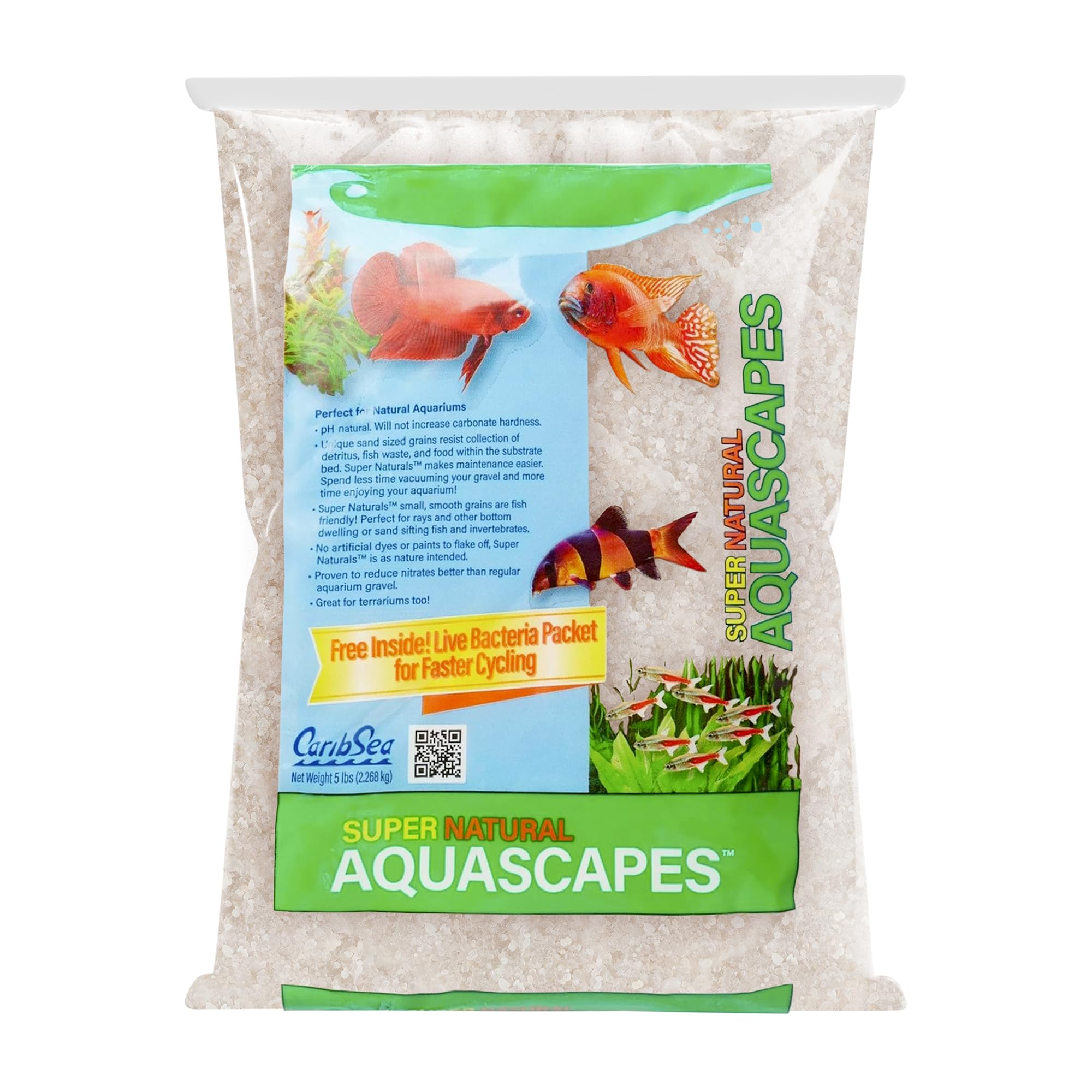
🌟 Make your aquarium the envy of every aquarist with Crystal River’s pristine natural sand!
CaribSea Super Naturals Aquarium Sand in Crystal River is a 20 lb premium natural substrate designed for freshwater aquariums. Its fine, neutral sand grains create a visually striking, crystal-clear riverbed effect that enhances aquascaping while supporting healthy plant root growth. Ideal for medium-sized tanks, it maintains water balance and promotes a clean, thriving aquatic habitat when properly rinsed and maintained.

| ASIN | B005QTEO66 |
| ASIN | B005QTEO66 |
| Age Range Description | All Life Stages |
| Best Sellers Rank | #12,530 in Pet Supplies ( See Top 100 in Pet Supplies ) #10 in Aquarium Sand |
| Brand Name | Carib Sea |
| Color | Crystal River |
| Customer Reviews | 4.6 4.6 out of 5 stars (8,424) |
| Date First Available | September 6, 2011 |
| Date First Available | September 6, 2011 |
| Department | Unisex-Adult |
| Department | Unisex-Adult |
| Directions | 1 |
| Included Components | Caribsea Super Naturals Aquarium Sand, 20-Pound, Crystal River |
| Is Discontinued By Manufacturer | No |
| Item Dimensions LxWxH | 12 x 8 x 10 inches |
| Item Package Dimensions L x W x H | 16.14 x 12.13 x 2.91 inches |
| Item Weight | 10 Pounds |
| Item model number | 00840 |
| Item model number | 00840 |
| Manufacturer | Caribsea |
| Manufacturer | Caribsea |
| Material | Plastic |
| Model Name | Caribsea Super Naturals Aquarium Sand, 20-Pound, Crystal River |
| Number of Items | 1 |
| Product Dimensions | 12 x 8 x 10 inches; 10 Pounds |
| Size | 20lb (Pack of 1) |
| Specific Uses for Product | Active |
| Target Audience Keyword | fish |
| Warranty Description | Warranty |
R**E
Incredible sand, but you MUST know details for results.
This sand is absolutely beautiful. My Rabbit snails enjoy digging and they love it. Add a mid-high value lighting and it will literally sparkle/shine and become the centerpiece for any room. As a plus, if you have aquatic plants, they will be very very happy in this substrate. But you may have to anchor them for a few weeks/months for their roots to catch on. However, you need to know details about your aquarium setup to bring out its true beauty and to manage it properly. If you are getting this sand because it “Looks pretty” and you think all there is to it is dumping it straight into the tank and doing nothing else, you are MISTAKEN. Don’t ignore this, I’m attempting to warn people because I couldn’t find a true detailed explanation in the reviews. I’m trying to save you money from ruining your filtration system, stressing your fish, and clouding your water. I’ll do my best to list details and instructions. 1) First you must know this sand is very fine. This means, that if you have strong filtration/air pump in your tank. You may consistently disturb the sand at the bottom, and the fine sand will be pulled into your system, destroying it. Depending on what you need, this could be an expensive out-of-pocket expense emergency that you have to purchase or your fish will die. And that’s if you’re lucky enough to notice it’s broken, before it’s too late. 2) You absolutely have to clean your sand before it is put into your aquarium, especially this one in particular. If you do not, you will have cloudy water for months. This will force you to empty your tank fully, clean it, and go back to Square-1. And/Or potentially harm your fish. I’ll leave a brief instruction on how to clean sand below. 3) You may have heard that sand can be dangerous for fish. This is true, IF you do ZERO maintenance. Every few days/once per week, you need to “Rake” your fingers through the sand. Yes that means underneath the decorations as well. You could probably get away with doing it less, but if you want to eliminate the chance of a random insta-kill on your fish, do it often. I’ll try to keep this part brief, but when your fish create waste and bacteria, it will fall to the bottom of the tank. If you miss cleaning it, after awhile the bacteria can become trapped in air bubbles below the surface. As the weeks go by, this trapped bacteria will become more and more toxic. Until one day, some sand movement releases a bubble, popping the toxic bacteria into the water. Usually, this sudden high toxicity will be too much for a fish to handle at the rate your filter can clean it. And it will perish or get sick. Raking the sand often will release the trapped bubbles. Preventing them from becoming toxic. 3) Clean your tank. It’s basic, I know but if you don’t know how often to clean it, look it up. Want the sand to look pretty? Clean your tank, but remember don’t keep it too clean. A little dirty is okay. Do all of these steps and you can ignore all of the negative reviews. This sand is grade A. That’s all I can really think of. Once again guys, I’m not here to preach to you, I’m just telling you how it is. And the truth is, most people don’t do their research and their aquatic creatures are unintentionally abused and being hurt. There are probably work-around’s for some of these that I don’t know about. And I may not be 100% accurate on my claims. All I’m trying to do is spread the word and get all of this confusing research out of the way. And organize it in one spot so you guys don’t have to put in the hours of studying like I did. I’m no expert, just a guy who love aquariums. INSTRUCTIONS ON HOW TO CLEAN SAND Items needed: Sand 10-Gallon Bucket Garden Hose A)Throw your sand in the bucket, only fill to about half maximum with sand. Shove the garden hose to the bottom-turn on full blast. B) As the water level rises above the sand, move the garden hose around the bottom and side-to-side until the bucket is full. Remove the hose, allow 5-10 seconds for the fine sand to settle. C) You will see murky water spinning around, carefully dump the water out. After awhile you will get better and better at this so that you will not spill any sand. Just be aware if some is being poured out or not. Repeat this process for about 20-30 minutes (yeah I know it’s a long time) until your water is crystal clear. Take care of your back when doing this by the way. If it hurts take a break or stretch. Thanks for reading if you made it this far. Good luck to you guys and please have a wonderful day :)
K**8
This changed my life, no kidding
I wish I never heard of tank gravel, and I'm ashamed it took me decades to try sand. This review is by a novice with sand, expert at aquarium care for tanks 10 gallons or less. I'm a betta loyalist. I used two bags and rinsed one; in the future, I'll do a rinse for speed. The water was uncomfortably cloudy for me but reading the reviews forced me to be patient. I let it cycle about four hours before I returned my betta Byumba & snail Datsun home. It was still cloudy, but two water tests an hour apart confirmed safety. The water was completely clear after almost three whole days. It was like a magic wand hit it. I switched to sand due to the never ending battle with algae. I cannot believe it took me this long. It's been over a month, the water is still perfectly clear and the only algae is so little I have to inspect it. Byumba enjoys moving the sand (he made a groove under his heater) & Datsun no longer avoids the bottom. It's life-changing, I tell you! I had to clean a very clogged filter* last week. It was wonderful because it proved the algae horror had ended. I have reviews on many tank items, but most of all I strongly recommend my filter and heater, good for up to 10 gal. Some bonus stuff about my 5.5 gal masterpiece: •I use plastic zip ties and regular super glue for designs, and redecor 3x/year. •I use slices of pool noodle to make floating holders for plants; I use zip ties or electric wire to secure the stalk if necessary. •I have a lucky bamboo, several pothos, a snake plant, and two baby monsteras flourishing and naturally cycling the water alongside the filter. I added the monsteras specifically to consume waste in order to starve algae growths. I no longer maintain aquatic plants due to the algae problems inherent to 5 gallon tanks. -I have a planted pothos with a branch rooting in the water. It's currently beginning to separate fully from the mother plant. •I find big rocks outside, set them in hot water and bleach overnight, sometimes glue them together, because it's beautiful free decor. Fun to make stuff too. •My only issue with the filter is the strong output. Byumba values a still water corner, I have to come up with ways to divert it. If you look closely at the Buddha, you'll notice a glass wall that directs the flow to the right. -that's the glass beer mug from dollar tree. I took a hammer and slowly broke it to the shape I needed, and then I filed the edges smooth with a foot file (it's the same grit as sandpaper). Datsun the snail has been all over the edges to confirm they're smooth, but I risked my own fingertips to make sure he didn't get sliced (I wouldn't have forgiven myself). •The driftwood and a mopani log in the back give the water a warm, amber tint, caused by tannins and good/fine for fish. If you add this, don't worry about the tint. •I keep the cat's bowl by the tank b/c it's lovely watching them interact a little. I hope this helps! It's dedicated to all the wonderful reviewers who've helped me tremendously. ✌🏼
J**H
Sand is good
The sand is of excellent quality, exhibiting minimal cloudiness in the water, which is beneficial for maintaining a clear aquatic environment. This particular substrate is favored by my loaches, as they enjoy burrowing and digging through it. The fine texture allows them to engage in their natural behaviors without causing excessive disturbance to the water clarity. Additionally, the sand's composition supports a healthy ecosystem, promoting beneficial bacteria growth while providing a comfortable habitat for these bottom-dwelling fish. Overall, this sand not only enhances the aesthetic appeal of the aquarium but also contributes positively to the well-being of its inhabitants.
S**Z
Best sand substrate for your aquairum
I love this sand. Once I rinsed it as the instructions say, and placed it inside the aquarium, it made it look so much nice than the gravel rocks I had inside. My fish also love it too! I had a cory peppered catfish that wasn't doing too well and once I put in the sand his energy changed drastically. If you have catfish, you need to have sand as the substrate. Anything else damages their barbels (whiskers) which happened in my case. This is the brand I would trust and use again.
A**R
It's fine, but overpriced
The sand does look nice and comes to you clean, it'll only take a minute to wash. My only problems are it's not very soft or fine, which is what I was looking for for cory catfish. Also, one bag only fills up about 5 gallons so I ended up having to mix 2 bags of this with play sand to fill up my 20 gallon. If you don't mind spending the money go ahead, but regular old play sand will do the job for a lot cheaper (it'll just take a lot longer to wash before you use it.)
E**M
All good
A**R
Placing a 1.5 inch layer of this material on top of our potted plants has solved our problems with Fungus Gnats. They can no longer burrow into the soil to lay their eggs. We'd tried hydrogen peroxide and mosquito dunks which would knock their numbers down for awhile but they kept coming back. Not anymore 😁 The sand is very clean, beautifully white, and the plants look much better.
M**E
This substrate provides a really nice natural environment for your tank. The sand is very soft, not sharp and it is very easy to clean. I have corydoras that are constantly searching the sand with their barbels for food. They have no problem with this substrate because the grains are of ideal size. Neither too fine, which makes your water dusty, and not too big like small rocks. In fact, the grains of sand are large enough to vacuum the bottom without losing too much substrate like fine sand does. Conversely, the grains are small enough so that debris (algae, excrement, food) cannot infiltrate the substrate. For rinsing: I put the sand in a large bowl and run fresh tap water through the bowl. When it's full, I stir and gently remove the water from the top. Then, I start again 5-6 times, being careful to avoid losing too much sand in the sink. Only the fine suspended particles need to be removed. Clean technique and without cloudy water: My tank being already in operation and planted, I put the sand directly into it with the bottle technique. To tell you the truth, my water didn't even get cloudy with this method! It consists in filling a plastic bottle (e.g. a 2L Coke bottle) with sand through a funnel. When your bottle is full, you screw the cap on and put the bottle in your tank as close to the bottom as possible. You unscrew the cap with your hands in the water and the sand flows out of the bottle without making any unwanted fog! This sand is perfect for not blurring the water! Quantity required: As an example, a minimum of two 5 pound bags are required for a 15 gallon aquarium of 41x39x39 cm (16x15x 5") to obtain a good two inches of sand. ================= Français ================= Ce substrat procure un environnement naturel vraiment très joli à votre aquarium. Le sable est très doux, aucunement coupant et il est très facile à nettoyer. J'ai des corydoras qui fouillent constamment le sable avec leurs barbillons pour trouver leur nourriture. Ils n'ont aucun problème avec ce substrat car les grains sont de taille idéale. Ni trop fin, qui rendent votre eau poussière, ni trop gros comme les petites roches. En fait, les grains de sable sont suffisamment gros pour aspirer le fond sans perdre une trop grande quantité de substrat comme le sable fin. À l'inverse, les grains sont suffisamment petits pour que les débris (algue, excrément, nourriture) ne puissent pas s'infiltrer dans le substrat. Pour le rinçage: J'ai mis le sable dans un grand bol et fait couler de l'eau fraîche du robinet dans le bol. Quand c'est plein, je remue et je vide délicatement l'eau sur le dessus. Puis, je recommence 5-6 fois en faisant attention de ne pas perdre trop de sable dans l'évier. Seules les particules fines en suspension doivent être débarrassées. Technique propre et sans eau brouillée: Mon aquarium étant déjà en fonction et planté, j'ai mis le sable directement dans celle-ci avec la technique de la bouteille. Pour tout vous dire, mon eau n'a même pas brouillée avec cette méthode! Il s'agit de remplir de sable une bouteille en plastique (ex. un 2L de Coke) avec un entonnoir. Quand votre bouteille est pleine, vous vissez le bouchon et entrer la bouteille dans votre aquarium le plus près que possible du fond. Vous dévissez le bouchon avec vos mains dans l'eau et le sable s'écoule de la bouteille sans faire de brouillard indésirable! Ce sable est parfait pour ne pas brouiller l'eau! Quantité requise: À titre d'exemple, au minimum deux sacs de 5 livres sont requis pour un aquarium 15 gallons de 41x39x39 cm (16x15x 5 po) afin d'obtenir un bon deux pouce de sable.
D**I
I love Carib Sea sand and highly recommend it to anyone who is beginner and looking to start a tank, it's easy to clean & makes the tank look absolutely stunning and incredibly natural. Make sure you give it a good wash before using though, I recommend getting a bucket pouring the stand in there and then sliding the bucket under the tap water outside from a hose into the bucket or in the bath tub, the sand is heavy enough that it won't spill, and for five-twelve minutes "knead" the sand as if it is dough, after that it's ready to use.
J**P
The website says that it is a 50 lb bag, but in reality, the bag itself reads 40 lbs. It is a 40 pound bag and not 50 pounds.
Trustpilot
2 weeks ago
2 weeks ago