Some deliveries may take a little longer than usual due to regional shipping conditions.

DOWNLOAD THE APP


Customer Services
Copyright © 2025 Desertcart Holdings Limited
DOWNLOAD THE APP
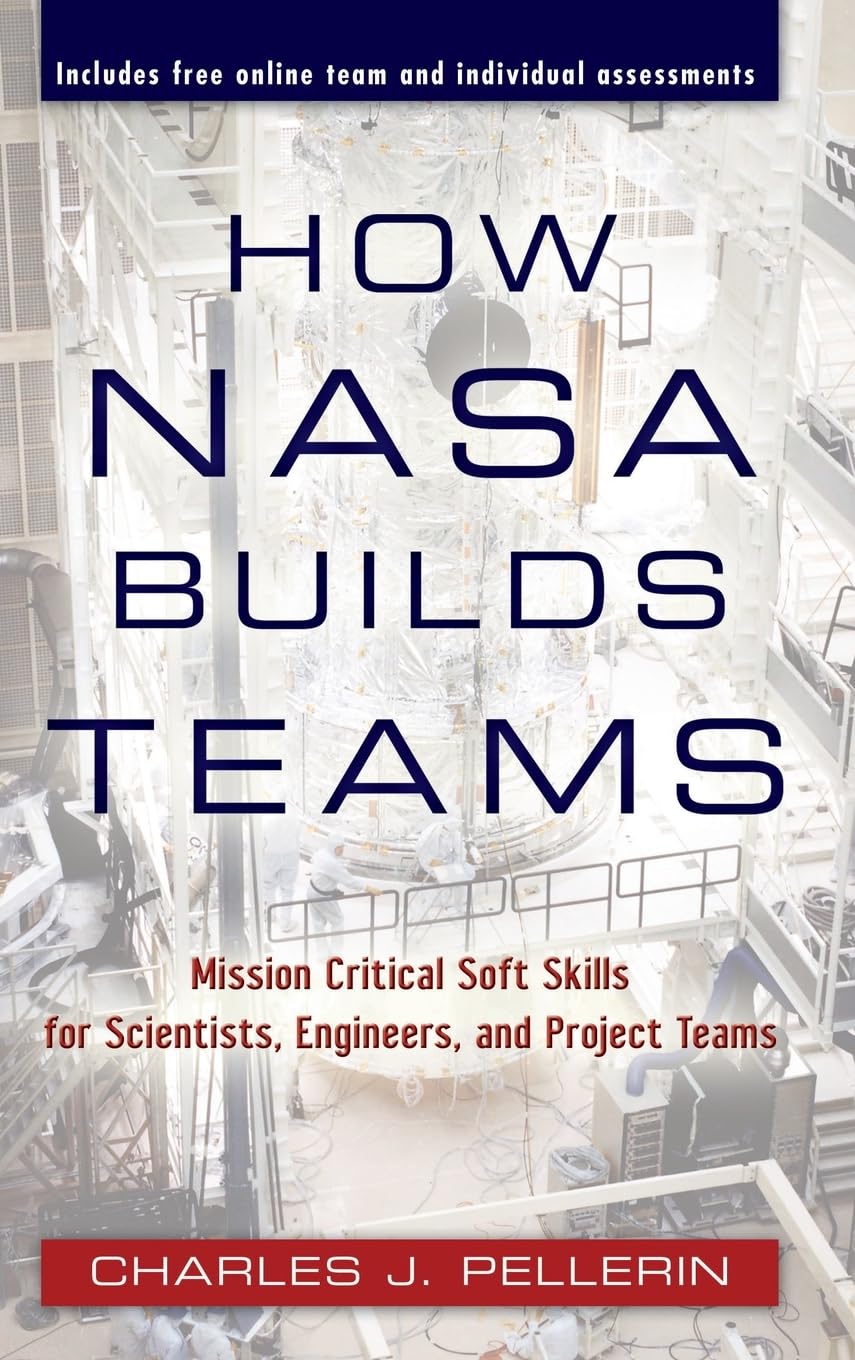
How NASA Builds Teams: Mission Critical Soft Skills for Scientists, Engineers, and Project Teams
J**H
Bound to be a Classic in Leadership and Team Building
Here we have a book for those of us who are fully committed to achieving breakthrough improvements in the performance of our teams. "How NASA Builds Teams" is based on a strong conceptual foundation that is vetted and fine-tuned with decades of experience. It offers solid advice on methods and techniques, which are refreshingly different from the standard prescriptions.In the introduction to the book, Dr. Charles Pellerin says, "You now have access to what I believe is the most effective teambuilding system in existence." I am sure anyone who reads the book and uses the resources on the website of 4-DSystems would fully agree with this statement.When I found this book after years of exploration in management and leadership, I realized that the simple framework offered by Dr. Pellerin is exactly what I needed. "How NASA Builds Teams" is one of those rare books that gives gestalt moments, several of them in every chapter.The author has spared the reader and practitioner from the intricacies of psychological theories. Yet it is evident that he has drawn from the works of great psychologists like Carl Gustav Jung. Dr. Pellerin acknowledges this, and develops Jung's concept of Psychological Types to use it effectively in the context of leadership and team development.The four dimensions that Dr. Pellerin has identified - Cultivating, Including, Visioning and Directing - proves to be the essence of effective leadership. It would be appropriate to say that these four dimensions are necessary and sufficient for effective leadership and high performance teams. The question would then be, "How do I develop these four dimensions in myself, and how do I help my team to operate in all these four dimensions?" Dr. Pellerin gives the answers, with convincing evidence based on his work with thousands of professionals and hundreds of teams from NASA and other high technology organizations. He urges us to discover our innate personality foundation. Being conscious about it helps us to build over our strengths and avoid the pitfalls of an extreme one-sidedness.Chapter 7 provides a comprehensive coverage of using the 4-D System to analyze cultures. Insights gained from reading this chapter would open our eyes to differences within and between teams. The book provides a simple framework for understanding culture and using that understanding to formulate marketing strategy, create winning proposals and manage project teams creating profound value for customers.Techniques for resolving interpersonal issues, dealing with conflicts, moving people to action and influencing them to give you what you want are key take-aways. He calls this Context Shifting, including examples from his work with clients - a contractor who won a $1 billion contract against tough competition, and another who was able to recover a denied fee of $3 million. The denied fee case is all too common. The usual outcome is a prolonged power struggle between the supplier and the customer. In contrast, the Context Shifting Worksheet enabled his clients to engage in the right dialogue process, which gave tangible results.In chapter 10, Dr. Pellerin talks about how our Story-lines influence others and us. Green Story-lines are liberating, and lead to high performance. Red Story-lines are limiting, and lead to inhibited performance. Leaders influence others through the words they speak. Great leaders run Green Story-lines and avoid Red Story-lines.Dr. Pellerin guides us through a set of eight behaviors, required for building and nurturing high performance teams. While talking about the importance of appreciation, he tells us: "I will tell you a small secret - appreciation is a business word for love. We all need it." Further, he talks about the importance of living our lives in a state of gratitude. Dr. Pellerin explains that excess criticism tips the team towards a negative culture, which in turn leads to poor team performance and even major disasters.Every manager and leader faces the question: `How should I deal with conflicts?' Dr. Pellerin's advice is simple and powerful: Identify and act on shared interests. He gives an example of his successful collaboration with Japanese scientists. He also cites his experience of managing a conflict that was preventing him from hiring an expert while preparing for the Hubble Servicing Mission. Almost every project manager can easily relate to dilemmas like this.Based on personal experience and observations, Dr. Pellerin tells us how effective leaders manage their persona (mask) and expression of authentic selves. His interview of his own persona makes for an interesting reading (pp. 179 -180). He says that personas prevent us from authentic relationships with others. Dr. Pellerin carefully explains the power of appropriate inclusion and the pitfalls of thoughtless omission. He explains how he dealt with sensitive issues related to resource allocation by listening deeply. He also provides guidelines for effective team meetings.Chapter 15 deals with building trustworthy contexts by honoring all commitments. We each demonstrate our trustworthiness, or lack thereof, by how we keep our agreements. The author provides a four-step process for dealing with broken agreements. Surprisingly, apologizing comes last in the process. The first step in the process is telling the truth, "I broke my agreement with you." This applies even when the circumstances leading to the breaking of the agreement were beyond one's control.In Chapter 16, titled Creating the Future You Want, Dr. Pellerin describes how he developed the Great Observatories program and faced the challenges of the Hubble Servicing Mission, strengthened by the power of 100 percent commitment. The narratives provide for enjoyable reading, even while the author conveys the most important lesson of all - commit yourself 100 percent to the results that you want to achieve. This is one of my favorite chapters in the book.I am grateful to Dr. Charlie Pellerin for sharing with us his wonderful insights through such a well-written book. One of the strengths of the book is that it avoids Guru-speak, which is all too common in the genre of management and leadership books. This could also be the reason it has not yet become a best seller on popularity ratings. However, I am sure that "How NASA Builds" Teams is a book that is bound to become a classic over time.
T**K
Personal Responsibility for Effective Team Relationships: The Difference Between I, Them, and Us
This is a book for people who care equally for themselves and everyone else. It reaches into discussions of your core personality "4-D" dimensions (which the author calls: cultivating, visioning, including, directing) which only you may ever understand (things even a parent or significant other may possibly notice without fully understanding). There are no magic checklists or guaranteed outcomes promised to the reader to reach a publicly visible state of accomplishment. Insights are absent on how to change everyone and everything else in your life, only how to change yourself.The author uses his own journey from a style of business, social, and personal relationships where he was the center of his own universe. That journey changed to one where all of his relationships are sustained as mutual team efforts. He shows how external perceptions of himself were often personally counter-productive because the public rewards were usually for what appears to have had happened vs. to what actual did and did not happen.What is provided is a way to have a discussion with yourself on how to relate effectively to yourself (your first team), significant others, family, social and work groups. The great thing about this book is that it offers a universal language (the book is being used in cultures around the world) of evaluating and improving all of these relationships. This book squarely places the responsibility for the improvement of your role in these relationships with yourself by suggesting processes and questions that you need to continuously improve your realizations, insights, and answers to ask even better questions of yourself. The visible past and present become perspectives to an improved personal future where all of your relationships (personal or business) benefit as well.The benefits of this for people working in groups of all types is that when those groups adopt the 4-D mutual relationship framework instead of the classic competitive and hierarchical relationship model, all that social energy becomes synergy of incredible magnitude. The quantitative measures such as productivity and accuracy are shown by the author when using his 4-D framework to have magnitudes of improvement vs. the few percentages promised by other approaches (like 10X or 100X rather than 10% or 100%). The benefits to organizations who use this book's approach of collegial vs. imposed values is very valuable to staff and all private and public stakeholders.This book is recommended for people who wish to take responsibility for their relationships and become their own mentor. Not in a few publicly visible easy steps, rather as a usually private personal process of continuous change and improvement. Very much recommended for groups who wish to have sustainable successful cultures and accomplishments.
S**3
A practical and useful guide on how to improve the effectiveness of teams ...
A practical and useful guide on how to improve the effectiveness of teams - especially when used with the free online tools.
B**E
Great Book! Practical, useful and valuable!
I was looking for a method to bring human relations skills to a group of engineers. Engineers are not "touchy feely" people and they usually look with some disdain upon "soft skills" as being irrelevant to their job. Charlie's book PROVES that these skills are not only relevant, but essential to projects achieving success. I liked the book because it gives real, quantified examples of how lack of "soft skills" training caused problems at NASA and its subcontractors.The book is supplemented by a web site which will allow you and your staff to conduct periodic and measurable evaluations, set up a seminar, and track your success as you implement the process.
V**R
Buch mau vs. Website wow
Ich gebe 'oneofmany' Recht, was das Buch anbelangt. Der wirkliche Wert der Methode erschließt sich erst durch den Besuch der Website (google: 4-D system Pellerin'. Hier sind 28 MB an kostenloser Information hinterlegt. Höchstwahrscheinlich sollte mit dem Buch irgendwie Geld reingebracht werden.
B**B
This is one long sales pitch
I bought this with high hopes that it might give some insights into building good teams. There are some useful nuggets that could be condensed into a few pages, but the rest is one very long and repetitive sales pitch.
Trustpilot
3 weeks ago
1 month ago