We remain fully operational. Our teams are working around the clock to ensure your deliveries continue safely.

DOWNLOAD THE APP


Customer Services
Copyright © 2025 Desertcart Holdings Limited
DOWNLOAD THE APP
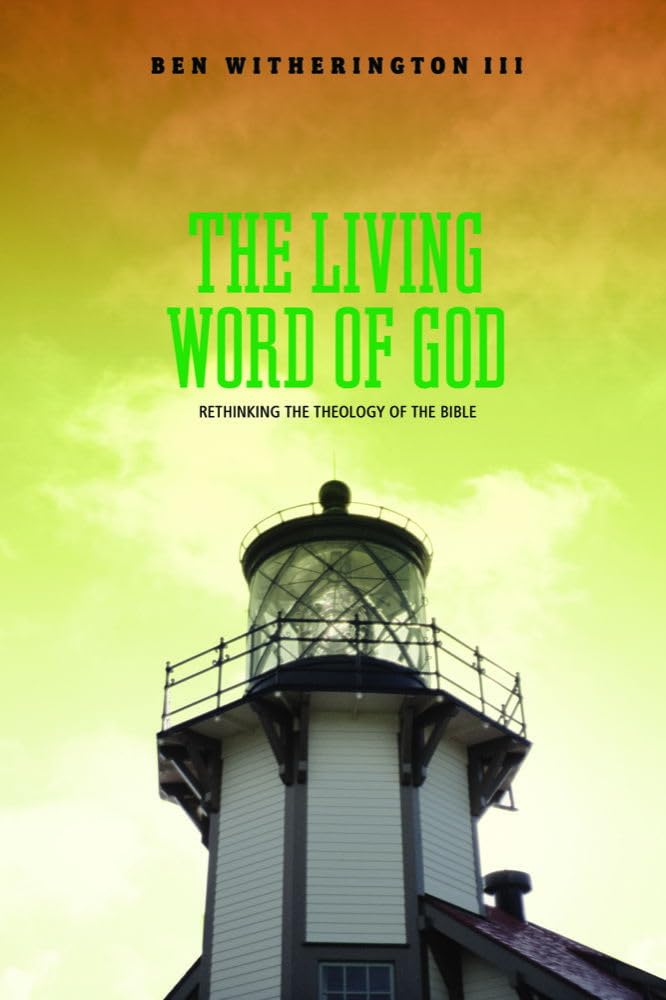
The Living Word of God: Rethinking the Theology of the Bible [Witherington III, Ben] on desertcart.com. *FREE* shipping on qualifying offers. The Living Word of God: Rethinking the Theology of the Bible Review: A mind stretcher - Ben Witherington never fails to write a book that challenges my thinking. This is definitely one of those books. Much of the content had me cheering in agreement; other (few) content had me frowning in disappointment or hesitant to agree with; still other content lit light bulbs above my head. Aside from my disagreements, Witherington very much maintains a high view of Scripture as the Word of God, and he remains a favorite author of mine to challenge my thinking. Review: Great Insights - I really appreciated how this book shared about the power of the spoken Word. I would recommend this for those interested in going a little deeper understanding the theology of the Bible.
| Best Sellers Rank | #1,059,463 in Books ( See Top 100 in Books ) #12,934 in Christian Evangelism (Books) #16,640 in Christian Theology (Books) |
| Customer Reviews | 4.2 4.2 out of 5 stars (11) |
| Dimensions | 6 x 0.84 x 9 inches |
| ISBN-10 | 1602581924 |
| ISBN-13 | 978-1602581920 |
| Item Weight | 1.1 pounds |
| Language | English |
| Print length | 291 pages |
| Publication date | September 1, 2009 |
| Publisher | Baylor University Press |
J**Z
A mind stretcher
Ben Witherington never fails to write a book that challenges my thinking. This is definitely one of those books. Much of the content had me cheering in agreement; other (few) content had me frowning in disappointment or hesitant to agree with; still other content lit light bulbs above my head. Aside from my disagreements, Witherington very much maintains a high view of Scripture as the Word of God, and he remains a favorite author of mine to challenge my thinking.
R**S
Great Insights
I really appreciated how this book shared about the power of the spoken Word. I would recommend this for those interested in going a little deeper understanding the theology of the Bible.
C**C
Three Stars
ok book
A**R
A good book for beginners
In this book, Witherington writes in response to 2 unhealthy patterns and attitudes to the bible he sees in today's world - on one hand, we have the fundamental conservatives who insist that everything in the bible is literally true, and understand the "authority" of scripture in a straightforward, literal sense, as demonstrated by Christians who insist the world is flat and square because Revelation speaks of how "angels came from four corners of the earth". On the other hand, we have the liberals, demonstrated by Erhman and his new book "Jesus Interrupted", pointing out that the bible is full of contradictions and cannot be trusted. In both cases, Witherington argues, there is ironically the same problem - a straightforward, simplistic approach to scripture that neglects fundamental issues that arise in the study of any piece of literature (religious including). In both cases, there is a neglect of the complexity of scripture, with both groups forgetting that texts can and should primarily be understood as they were meant to be understood - eg: we should not be reading a comic strip as if the statements within where academic literature. For example, liberal theologians often have an issue with the chronological differences between the four gospels - forgetting that biographies written 2000 years ago were not seeking to establish historical chronicity or accuracy, but rather sought to demonstrate and describe a persons life in particular themes. In essense - biography is different from history (especially ancient biogrpahy and ancient history). Witherington spends much of the book look at specific issues and case studies - for example household regulations found within colossians and whether Paul is inadvertently promoting slavery and patriarchal systems, and discussing how a surface interpretation of the text will not suffice to do justice to it and the theology drawn from it. He also devotes 1/4 of the entire book to a QnA section, where he answers some of the most common questions he receives from the general public about the bible. This book probably underachieves to some extent - it is entitled "rethinking the theology of the bible", but in reality Witherington does little more than to put forth a stock standard, if well thought out argument for the proper and careful exegesis of scripture and its application to Christian life. His arguments are not groundbreaking, and would be what you expect from any reasonable book on hermeneutics. Where it does shine, however, is the (rather slim) chapter on postmodernism - and a brief commentary on self proclaimed postmodern christians, such as Brian Mclaren, Rob Bell and Dan Miller. In this, he effectively argues that they aren't true postmodernists, demonstrating that Christians, both professional and lay, often have a misconception of what true postmodernism is, and how it impacts the way we read scripture. Alas, this chapter is rather short. In summary, "The Living Word of God" puts forth a good case for the need to properly and carefully handle the Christian scriptures, and warns against the fallacies committed by both liberal and fundamentalist camps. It is a book that is perhaps written more for the student who is beginning his/her journey in the study of the scriptures, than for the seasoned and experienced exegete. Nonetheless, the QnA sections, the Case Study sections and a few others do provide some gems and food for thought for someone more experienced.
C**S
A Good Book on Approaching and Understanding the Bible as God's Word
Ben Witherington proves himself expertly versed in an orthodox understanding of Scripture. He explains various elements of properly reading and interpreting Scripture in accord with the gospel of Jesus Christ. Many of the topics of the book would be helpful as an introduction to the Bible. Other discussions seem more tuned to seminary types of discussions regarding nuanced ways to describe Scripture as God's word. Whether the reader is a seminary graduate or someone learning how to interpret Scripture, some topics will be interesting and others may seem to target another audience. He teaches on very relevant topics for all Christians regarding Scripture in our contemporary circumstances. These include the timeless inspiration and prophetic message of Scripture, consistent rules of interpretation, dangers of trying to adjust interpretation to fit cultural trends, trustworthiness of Scripture and the variety of translations. He also devotes a chapter to an interaction with another author Peter Enns regarding Scripture as analogy. I thought this chapter was out of context with the rest of the book. In all things, Witherington promotes a christocentric reading and understanding of all Scripture. As Jesus is the center of the Christian faith, so he is the center of a faithful reading of the Old and New Testaments. The book as an extended appendix that has Q & A with Witherington on all sorts of Biblical questions. These are interesting and helpful.
Trustpilot
2 weeks ago
2 weeks ago