


🔋 Power your lifestyle anywhere — never get caught powerless again!
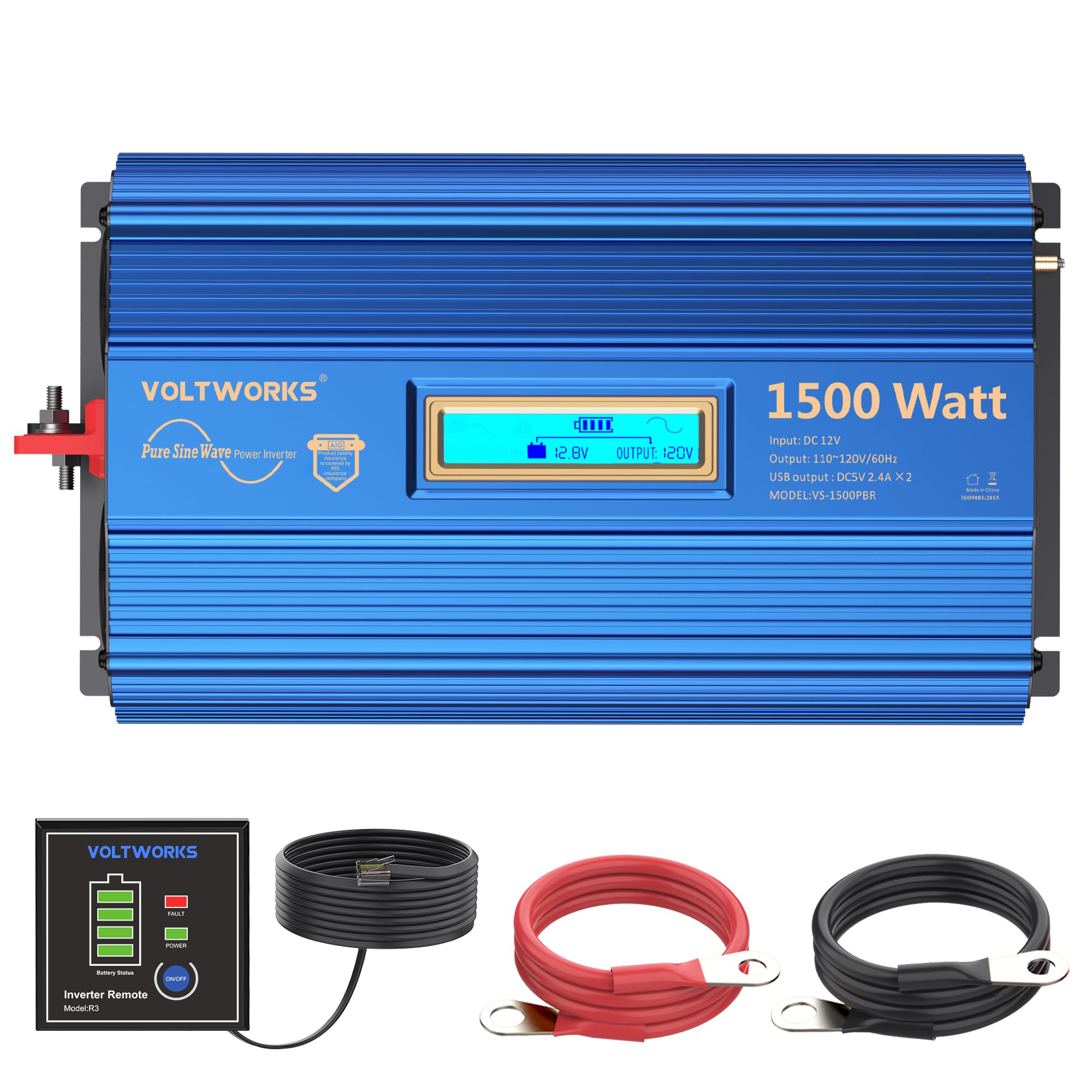
The VOLTWORKS 1500W Pure Sine Wave Inverter converts 12V DC to clean 120V AC power with 3 AC outlets and 2 USB ports, ideal for home, RV, truck, or emergency use. Featuring a remote control and LCD display, it offers real-time monitoring and convenient operation. Its advanced protection systems and durable aluminum casing ensure safe, efficient, and quiet performance, backed by an 18-month warranty.


| ASIN | B07T2GNHQM |
| Antenna Location | Car, Truck, Recreational Vehicle, Boat, Office, Home, Camping, Road trips, Business trip, Hurricane, Storm, Workshop |
| Battery Capacity | 150 Amp Hours |
| Best Sellers Rank | #44,121 in Automotive ( See Top 100 in Automotive ) #106 in Power Inverters |
| Brand | VOLTWORKS |
| Built-In Media | 1500W pure sine wave inverter, 2FT Battery Cables, 3ft Earth Wire, Remote Controller |
| Color | Blue |
| Customer Reviews | 4.5 out of 5 stars 818 Reviews |
| Display Type | LCD |
| Electrical Output Waveform | Pure Sine Wave |
| Frequency | 60 Hz |
| Input Voltage | 12 Volts (DC) |
| Inverter Capacity Volt-Amp | 1500 |
| Item Dimensions L x W x H | 14.5"L x 8"W x 3.9"H |
| Item Height | 3.9 inches |
| Item Weight | 8.7 Pounds |
| Manufacturer | VOLTWORKS |
| Model Name | VS-1500 |
| Model Number | VS-1500PBR |
| Number of Outlets | 5 |
| Output Power | 1500 Watts |
| Output Voltage | 120 Volts |
| Peak Output Power Watts | 3000 |
| Power Source | DC 12V |
| Recommended Uses For Product | Car, Truck, Recreational Vehicle, Boat, Office, Home, Camping, Road trips, Business trip, Hurricane, Storm, Workshop Recommended Uses For Product Car, Truck, Recreational Vehicle, Boat, Office, Home, Camping, Road trips, Business trip, Hurricane, Storm, Workshop See more |
| Standby Power Shutoff | 90% |
| UPC | 791300751982 |
| Voltage | 120 Volts (AC) |
| Warranty Description | 18 Months warranty |
| Wattage | 1500 watts |
K**S
Excellent Performance +(1 year update) +(Second Inverter)
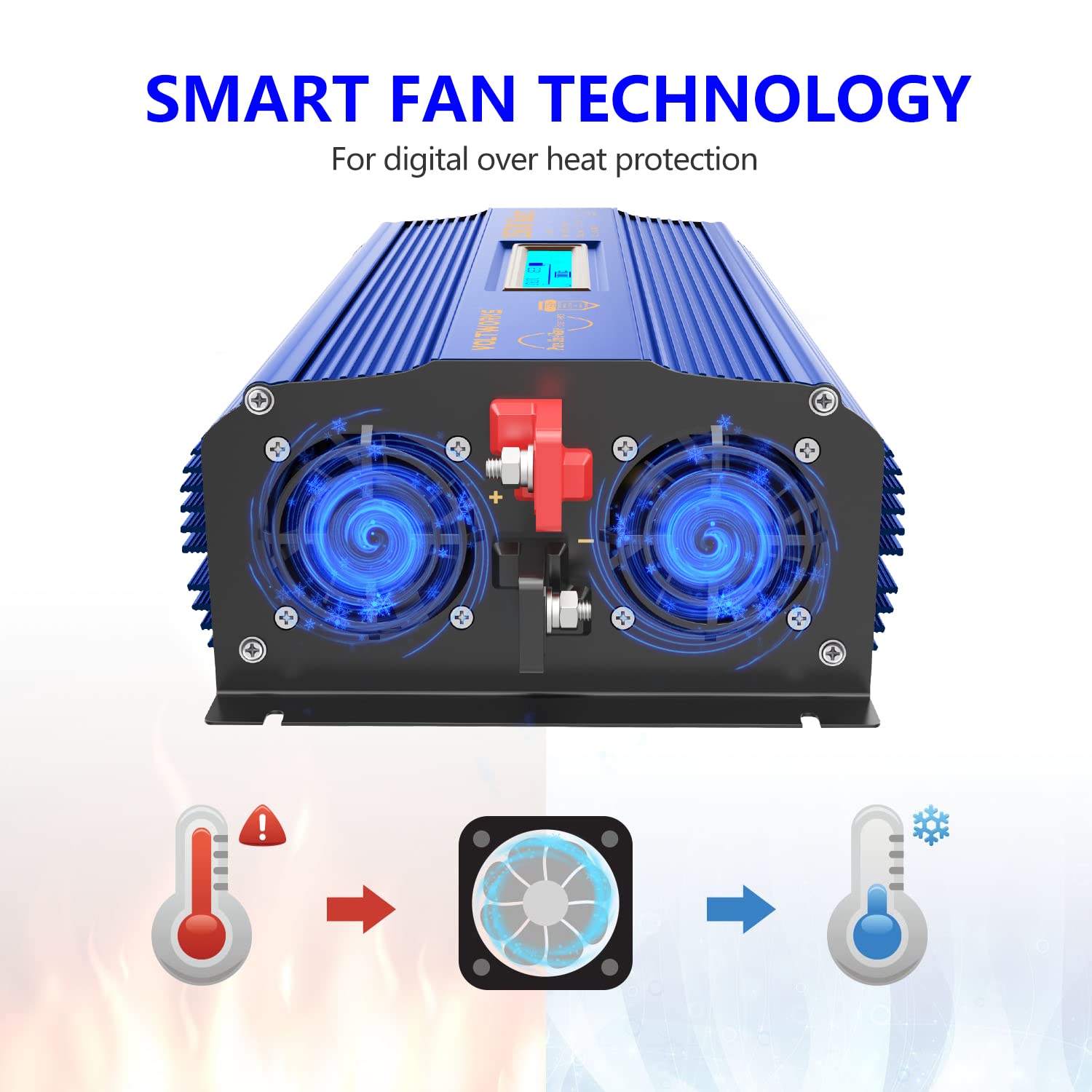
I bought this inverter when I changed my system configuration to 24V. My old inverter was a 12V 1500Watt Pure Sine Wave and ran about 115V. It ran most things well, but couldn't handle my large ShopVac, and even with a minor load the fans on the inverter would cycle every couple minutes. This inverter runs everything I plug into it including a ShopVac and Refrigerator simultaneously. Its output is ~120V, the voltage drops little with heavy loads. Running 1,200 watts voltage does not go below 117V and averages around 118V. The fan rarely operates, in-fact it never cycles when the continuous load is less than 150W. So for me it will run my refrigerator and be absolutely silent. Had me worried at first that the fans might not work but the unit stays cool to the touch and the fans do work. Fan only runs when the unit hits 104F, so just keep the inverter in a nominal conditioned space of <80 degrees and you are good. My tests show it meets the claimed 90% efficiency and no load current of .9A (inverter on but no load). Power when turned off was in the milliamp range. I disliked the remote and lack of information on the pin-out as I use a relay to start the inverter. To turn on the inverter you either; push the button on the unit, button on remote, or use a relay to short pins 1+2 at the RJ9 port for ONE SECOND. Shorter duration will likely fail as the unit has to come up to the proper voltage for startup. I disliked the use of an RJ9 port, this is the narrow plug used on telephone handsets. Making it "unusual" to work with. And I had to buy some RJ9 crimp plugs for my bench stock. The information on the RJ9 port pin-4 is some kind of pulse coding, almost looks like garage door coding on my scope and the pulse duration and amplitude seems to follow the load. I am simply processing it as an analog signal (milli-volts) to determine if the inverter is on or off. The handheld remote provided does work, but having that wire is like being tied to a leash. Just seems like something you would have in the 80s. Hoping to get more information from the company. Other than those few issues, I rate this inverter as Excellent. 1 Year Update: - Zero issues with this inverter for the past year. Not even an overload restart. - I use it 24/7, my daily peak is about 900Watts but on average I am drawing 280Watts from it 24/7. - Running from the inverter 24/7 are: 1 standard 17+cubic foot Refrigerator, 1 Air Cleaner, 2 PC Computers, 1 Base Station GMRS Radio, 1 Laptop, 2 End-Table Lamps and several USB charging stations. - Unit runs at 92% efficiency which is above the stated 90% efficiency. So for me if I draw 1000Watts of DC from the battery will run 920Watts of AC loads. This is great efficiency for any inverter. - The outlets are NOT GFCI (ground fault) protected. This is now a USA code issue for household inverter power, if you wish to have this feature I recommend you buy a GFCI with a pigtail plug. You plug that into the inverter and connect your loads to it. - GFCI or not make sure you ground the unit case solidly (quality connection). In addition (meaning you still need the case ground), you may want to connect the one of the inverter outlet grounds to a grid ground receptacle. DIY two male plugs and one wire, a 12AWG green wire. Just make sure both ends connect to ground or be ready for sparks and flames. - I stopped using the outlet signal from the RJ9 plug (pin 3/4) to determine on/off status of the inverter. Instead I use the 5Volt signal from the inverters USB port to determine status. (dah on me for not doing this first). And this USB method would likely work well with a small 5Volt relay. - Still using RJ9 port pin 1/2 to operate the inverter. Remember, needs to be shorted for 1 second to turn the unit on. - Picture 1 shows my rather custom and elaborate setup that may help some of you. - Picture 2 I included only for the DIY aspect of the lighted plug. Really some good benefits to using these lighted plugs... its lit so the inverter is on and electricity is at the plug. - I have an external box that my loads connect too. Inside the box I have a dual pole 16Amp supplemental circuit breaker and a contactor. The circuit breaker is as stated, supplemental. The contactor I use with a control system to transfer between inverter and grid. - This is a high frequency inverter so it is best for non-motor (non-inductive) loads, but clearly it handles my refrigerator and occasionally my shopvac without issue. However, if you plan on running something like a sump pump or AC at 1HP or more you may consider a higher rated inverter, or a similarly power rated Low Frequency Inverter. Low Frequency Inverters are bigger and cost more... But nothing beats getting the right stuff for the task you require of it. Bought a Second One My systems operates 24/7 as Off-Grid inverters do. Most of the components in my system were redundant. Multiple panels can be reconfigured, 2 charge controllers, 8 batteries etc. But the one single point of failure for me is the Inverter. So after running the first inverter for over a year with zero problems I bought a second one. Bagged up the first one and the second one has now been running flawlessly 24/7 for just over a month. The plugs were exactly the same, and it is performing exactly the same. My inspection of the unit that has been running for a year showed absolutely nothing of concern, and I was happy to see not much dust/dirt buildup on the fan or components. With electronics in general if they run for 90 days they tend to last a long time thereafter, often called a "burn-in" phase. Thinking this was another home run.... will do a third update if it proves untrue.
A**8
As compared to a few different size (wattage) inverters, all 24 volt
Summary: I have a small solar/PV system (880W panels), 24 volt, 165AH (six batteries). I first ordered a 6000W inverter which ended up being way too big for this system. So I ordered this 2000W Voltworks, but the over night parasitic draw was still too much, so going with an even smaller 300W (only powering a 15W 120VAC load). I still use the 2000W when I charge my 56V Ego Batteries, as that charger draws 550-600W. I also ran a 300W rice cooker off the 2000W. Observations: The power switch has a built-in safety where by you need to press and hold for a half second, before the inverter will start. This does not apply to turning it OFF. The amp draw when connected and turned off is 90 mA. Turned on, with nothing connected is 420 mA. The reported input DC voltage matched the output of my MPPT controller (26.4VDC). The AC voltage was pretty close, Inverter said 121VAC, and the power/energy meter said 122.7VAC. Setup: For DC power cables, having a good connection is important for efficiency and safety. Doing a pull test on the RED/BLACK cables revealed that the power cables are crimped correctly (did not cut off the heat shrink to check if they are soldered). Recommendations: 1) When it comes to inverters, some basics are that Pure Sine is more efficient that Modified Sine, and also highly recommended for sensitive electronics. Your load type, e.g. low or high current appliances will drive your sizing. If you have a high surge tool like a power saw, you'll need to size it 3-7 times higher than the running power requirement. 2) Check the DC power cables for loose crimping on the lugs. Solder them for extra assurance. Pros: Good fit & finish; runs the computer and 55" TV without and issues. Cons: The display on top is bright, but there is no way to turn it off. The 6mm nuts for the power inputs are a little small, and I prefer to have a non-conductive knob on there for extra isolation protection. I ordered some replacement knobs. Conclusion: At $350, rating this 5-stars. Related Products: XYZ INVT 300 watt Pure Sine Wave Inverter Peak 600W ~ $80 https://www.amazon.com/gp/product/B08PY1851P BESTEK 300Watt Pure Sine Wave 12V ~ $46 https://www.amazon.com/gp/product/B08L8Z9PWG
L**S
Powers my 55" Tv!
Update 4-26-2021 My system has grown quite a bit and I have lots of new equipment. Although it might not look as clean it is much more powerful and the inverter now runs flawlessly day and night. I basically never turn it off except when the sun doesnt come out for 48 hours or more. My shunt shows I run about 70kwh through the inverter every month. I can confirm that this will power a 700 watt microwave with no issues at all. (700 watt advertised microwave is actually 1100 watt draw, which is 1300 after inverter efficiency losses.) Also have tested a 5000 btu window unit air conditioner and it works just fine. I am very pleased with this item :) Update 6-18-2020 Voltworks responded promptly to my email and was very courteous. They asked questions about my unit and took care of the problem right away. I am currently waiting for a replacement to arrive and im happy to see this company honors their warranty! Update 06-12-2020 I have been using this inverter everyday since the day I wrote the 2nd review with a new set up (vertical) and it has performed flawlessly until now. This morning I turned it on like I do every morning and it gave a very loud buzzer so I immediately turned it off. waited 10 seconds and tried again and nothing. No sound, no lights, no power at all. I have emailed the company as the photos and the box which I still have both state 18 months warranty. I have not yet received a response but will continue to wait.. Update 10-15-2019 So far ive used it to charge my macbook, power drill, gopro batteries, a few portable power banks, and a fan. No issues to report! Works great! (oct 3 2019)I was worried this inverter might not be enough just because i have a doubtful nature and i could not find any videos of it supporting a tv that is 55" Took a chance and i am happy so far! Tested it last night and it powered my 55" for 2 hours off a 100ah AGM battery. Worth the money!
M**O
Good Inverter, junk wire.
I bought this to install in my small travel trailer. I plan on doing a lot of long road trips and will be boondocking (dry camping) along the way. I wanted to be able to run a coffee brewer(1000watt) and the microwave(1000watt). I chose the 2000watt pure sinewave with 2 outlets and an ac hard wire terminal mostly because of the microwave. I know a 1000watt microwave has a substantial start up surge. I installed 2 outlets in camper that will run off the inverter. I found that the inverter cannot consistantly handle the initial surge of microwave if the battery voltage (2x12v rv/marine size 24 lead acid) is below 12.5 volts. The microwave makes a buzzing noise and the inverter shuts off. Sometimes the inverter successfully powers microwave at 12.0-12.4 volts, but it seems to be hit or miss. I find that if my voltage is below 12.5v I have to try the microwave, if it buzzes I immediately stop it and try again before the inverter kicks off. I can run coffee maker no problem even below 12v on batteries. My other concern is the cooling fans never kick on at all. I ran a 1500 watt electric heater for ten minutes and no cooling fans, blades not spinning. The inverter however only got warm to the touch (65f room temp) Not sure if fans are defective or if the inverter just cools very well through the heat dissipating casing. The casing does have a large surface area with a lot of fins on it. I am hesitant about the durability/longevity of this unit given its performance running a 1000watt microwave. Wish the power supply cables were a little longer. Seems a lot of these inverters come with short cables. Wish it came with at least 3 foot cables and a voltage display on the remote either in addition to, or instead of the 4 bar battery level meter. I will update on long term performance and failure if it happens. Hoping it proves to be reliable. *Update 9/3/22; Installed in camper, tried to run microwave/convection oven combo in camper with fully charged batteries. Runs 10 to 15 seconds and powers off. I tested it prior to install with a 1000 watt counter top microwave with mixed results, rv microwave is just too much for it. Went and got a 700 watt microwave, will only run it 25 seconds. Tried my 1000watt coffee maker that it ran prior to hardwire install successfully, won't even brew a cup before shutting down. Apparently can't handle longer battery leads, or being wired to outlets. *Update 9/4/22; Had about given up on this inverter performing properly. Did some research online and decided to try a different supply wire. Got some 2 gauge 6 foot wires at Harbor Freight. Inverter now performs well, even when battery voltage is as low as twelve volts it will still maintain 113-115 volts ac while running a 1000watt microwave. This is while running through hard wired outlets in camper. Conclusion, the problems were the result of deficient wire the manufacturer supplied with the inverter. The 6 foot long 2 gauge wire allows the inverter to perform much better than the 2 foot long 2 x 5 gauge wire supplied. I cut one of the crap cables and discovered they are not even 5 gauge, closer to 6 gauge and very thin wire strands. They used thick casing to make the wires appear thicker than they are. I am giving inverter an overall rating of 4 stars. Would be 5 if they had supplied wire adequate to run the unit properly. Still will update on long term performance and reliability.
C**S
Nice 24v inverter!
This is my second purchase of this inverter and I'm very pleased with its performance. The remote control works well, but I'd like to see the actual battery voltage displayed, not just a bar graph. I really like the soft start feature which has allowed me to run the A/C unit in my shop with it, which other inverters the same size could not do. It also has good overload protection. It works well in my little 2.4kw portable solar unit, combined with 730 watts of solar input and 2-100ah LiFePO batteries.
R**.
Works well.
I have been using this over a year to run my pond pumps. No issues.
A**R
Looked so good unfortunately mine was short lived (30 minutes)
I carefully review several inverters before choosing this one because of the reviews and Looks and sounded good. Unfortunate after installing my entire solar system several days and battery bank I started the inverter up with a small fan running just to see how fast it may drain the batteries and how the inverter would handle or heat up with a minor load . After about 30 mins a funny smell filled the air and I almost turned it off cause I was just about sure that was an electrical type of burning smell but the units fan was not even running the fan I had plugged in began to make a funny sound Simultaneously as well so I looked at the inverter and it’s seemed ok I was sure all connections were tight but doubled checked everything. And looking at the inverter display it’s only putting out 62 voltsand fluctuating uncontrollably to 50 something volts the 60’s! Not the needed 120 volts so I tried restarting it several times and each time it was unable to raise the voltage I have a good volt meter and everything else was great only this inverter was definitely not performing properly I am running 12- 6 volt golf car batteries for a 12 volt system all brand new fully charged running with 4/0 cable in a series parallel only 10 ft. From the bank to the inverter way more than enough power! I hooked up my 10 year old Walmart - Everstart 750 watt inverter been running the little fan for the last two days no problem at only 25 percent off it capacities lol. Had so much enthusiasm about this inverter and just like that it was over. Sending it back going to try another brand. At least it happened right away not Months from now when I’d have to wait for a repair job instead. Anyways maybe mine me was just a fluke but I live on an Island out in the pacific and if there’s an outage as there often is I need something reliable.
F**R
This is a really good quality inverter
This is a good quality inverter. I tested it thoroughly and it handles right up to 2000 watts. I checked the sine wave with my oscilloscope and it is indeed a true sine wave inverter and the sine wave stayed fairly stable under load. The inside looks to be of good quality components. I use this on a daily basis to run my refrigerator and electronics off of solar charging a battery bank. It's pretty darned efficient too. I think I measured a bit over .3 amps no-load power consumption and it measured out to be 90% efficient. My only beef with this is it does NOT have a 4000 watt surge capability as claimed. That is entirely false. What it does is if it gets a load over 2000 watts (like from a capacitive motor) it shuts off, and then restarts slowly ramping up the voltage. They call this "soft start". It works, but is not the best for electronics. And that is entirely not the definition of surge capacity. A true surge capacity inverter has big transformers that can handle momentary power demand (like a second or two). I would give it a 4-star rating because of that but am giving it a 5 star to offset the 3-stars by a couple of nimrods - who accidentally plugged his into wall power and then complained that it blew up, and the other who complained it doesn't run his Instapot and wished it had three outlets.
Trustpilot
1 month ago
2 weeks ago