
DOWNLOAD THE APP


Customer Services
Copyright © 2025 Desertcart Holdings Limited
DOWNLOAD THE APP
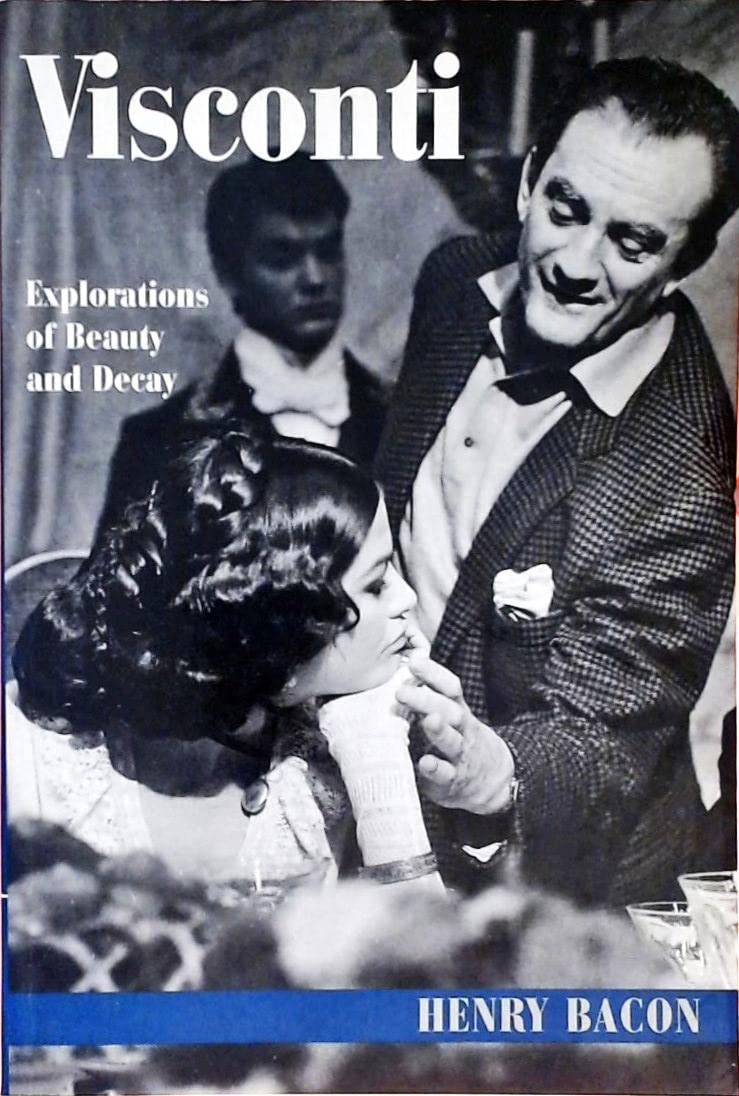
Visconti: Explorations of Beauty and Decay
A**R
The Ultimate Visconti
Henry Bacon has proven himself a brilliant researcher and author by writing the finest, and truest account of the master of film Luchino Visconti. Bacon's book is a highly detailed, fact filled documentary of the director's vision as it relates to his spectacular career. The book is the ultimate guide to anyone studying film or researching Visconti. Bacon has properly and intelligently put into context Visconti's aristocratic background in relation to his developing career, he has included every single film, and planned project including those that have been lost, and goes in-depth to discuss Visconti's frame of mind, project by project, and how his entire brillant career developed. Bacon has a clear intellectual knowledge of the true Visconti and has the facts to back up his claims. The work is in itself a masterpiece of film research. It is truly the finest biographical documentary of Visconti to date.
N**Y
Sinister Beauty
This is not a biography of Luchino Visconti; rather, it is a valuable insight into the director's filmwork. It is subtitled `Explorations of Beauty and Decay'.In his introduction, the author informs us that, "This book examines Visconti's films against their cultural, historical, and social backgrounds. The sometimes tortuous production histories and practical problems that shaped certain films as well as Visconti's personal life are treated here only insofar as they shed light on the formation of his films or offer a key to richer interpretations of them." The book is organised into five chapters according to theme rather than each work being treated in chronological order. There are no plates.The first chapter treats Visconti's relationship to Neorealism. This covers much of his early work, including `Ossessione' and `La Terra Trema'. The author writes how Visconti "wanted to convey the internal life of his characters through their behaviour and their relationship to the environment, to capture their essence by showing them as an organic part of a certain social reality."Chapter two assesses the two Risorgimento films `Senso' and `The Leopard'. Here, generally "Visconti's characters are destroyed because their feelings and passions blind them, prevent them from understanding and/or accepting the objective factors that condition their lives." There is an excellent essay on `Senso', outlining the production problems and the political context of its post-production. There are perceptive insights into character and plot of both these films that enhances subsequent viewings. The author shows how "There are important dinner scenes in almost all of Visconti's films, always functioning as the place where social and psychological alliances and antagonisms are encountered at their densest.The third essay explores Visconti's take on modern Italian society and family life, as seen for example in `Rocco and His Brothers' and `Conversation Piece'. Here, it is demonstrated how in most of his films set in contemporary society, "the families are in a state of disintegration." Moreover, "The centrality of families in Visconti's films is marked by the conspicuous absence of fathers ... Mothers receive only slightly better treatment." The critique of `Conversation Piece' is very good: the comfort and terror of solitude.Visconti's relationship with Germany is the subject of the fourth chapter. `The Damned' is cogently argued as Visconti's most Shakespearian film, its "sinister beauty" making it also difficult to watch. As for `Death in Venice', "for many critics, the main problem of the film is closely connected with the fact that Tadzio has had to be visualised." The third of the trilogy sees King Ludwig "doomed never to mature" because he is "unable to relinquish the desire for what he cannot obtain". Becoming "increasingly alienated from reality ... that reality refuses to tolerate him anymore."Visconti's adaptations of works of European literature are the subject of the final chapter, the author comparing him to a cinematic Balzac, and pointing out that the director not so much adapts as adopts literature for filmic purposes. Interestingly, "The main characters of the last four films are all lonely men, who in their various ways are emphatically not, or are no longer, fathers." Autobiographical perhaps? Indeed, there were critics who thought that adapting `L'Innocente' "was a logical ending for Visconti's career."Despite the author's academic credentials, I am pleased to say that most of the book is written in a readable style, although there are occasional trips into arcane theory that sometimes besets `film studies'. Just one example will suffice: Ricoeur's translation of Aristotle's conception of `mimesis' "implies the need for a conceptual separation between the indexical relationship the cinematic image has with the pro-filmic event and the organisation of the cinematic discourse in terms of mimetic configuration, that is, plot." Apparently. There are 26 pages of notes.A few of the films described are (so far) unknown to me, but this book has inspired me to track these down. Alas, many have yet to reach the DVD market. The book comes with a complete filmography as well as a list of his stage productions and unrealised film projects. There is a bibliography and index.
A**S
Visconti: Explorations of Beauty and Decay
This is a very comprehensive book on the entire work of Visconti. It explores the main thematic preoccupations that fascinated the director and reveals them in an accessible manner to the reader. I feel perhaps a little more work could have been done on the later works where the films got more personal and the aesthetic more stylized. I also think more discussion on the operatic and the visual influences could have been further explored, especially in terms of European high art, stills from the films would have added to this (there are not pictures in the book save for the cover!). The melos (music) used within films is covered with exquisite detail as are the political frameworks/settings of many of the films. Most importantly the book is in English! (many studies of Visconti are not translated, especially from the French). For anyone that loves the director and his films, as I do, it is a must to own, and has a brilliant reference section.
Trustpilot
1 week ago
2 months ago