Some deliveries may take a little longer than usual due to regional shipping conditions.

DOWNLOAD THE APP


Customer Services
Copyright © 2025 Desertcart Holdings Limited
DOWNLOAD THE APP

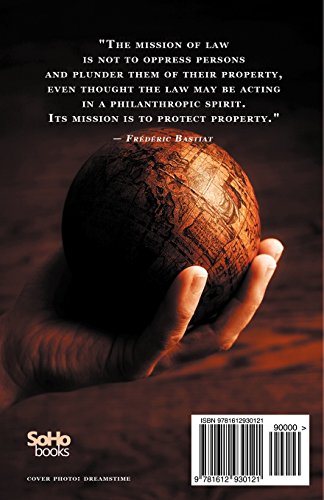
Review Full of truths that are not merely relevant, but are absolutely vital to our future. --Congressman Dick ArmeyNo work before or since has made such a compelling case for freedom. Bastiat's message will influence students of liberty for years to come. --Andrea Millen Rich, Laissez Faire Books Read more About the Author Frederic Bastiat, who was born two hundred years ago, was a leader of the French laissez-faire tradition in the first half of the nineteenth century. He was influenced by Cobden's Anti-Corn Law League and became a convinced free trader. Joseph Schumpeter described Bastiat as "the most brilliant economic journalist who ever lived." Read more
H**N
Very readable and understndable
The one dissenter of the philosophers of the day during the before and after periods of the French revolution. This man will help any American to see what is true and good about the Constitution for the United States. After all, France adopted our constitution shortly after we did .. . .. as United States born Natural persons.
C**A
This was life changing for me. Everyone should read.
This book changed my view of the world, and my peers, and my expectations of life. A concept so simple and straight forward. Translated from early 1800s French, it can take a small adjustment to wording if you aren't used to it.So amazingly far ahead of its time, you realize that none of the current political world is new. This has all been tried before...
K**S
Thought-Provoking Essay, But Strong Assumptions Aren't Explored
Bastiat is a good essayist, and his main point is well-taken. One should be careful about social policy, it involves real people. However, some of the things he takes issue with seem to be preoccupations you might expect for the well-to-do in the 19th century.Law is justice. What is justice, though? Bastiat thinks that if a person would do something and it would be considered wrong, then if a government does it, likewise it is wrong [focusing on taking what others have]. This sounds like a sound principle, but falls apart almost immediately upon some inspection. A group may have properties that an individual does not (the famous example being atoms are invisible, but things made of atoms are not necessarily so), and so it seems to me that we can accept governments can do things that we would not individuals to do. It may or may not be true, but the reason cannot come from examples for individuals. For example, we let governments enforce the law and carry-out punishments. I'm sure Bastiat would answer that these sorts of things are only the sorts of things that people would agree to, and so it would not be compulsory, but undoubtedly some would not agree, and so then it is not clear what should be done. Perhaps he's right that without a government people will rationally choose to give up things, but my own experience tends to tell me that poor Nash equilibria (such as for air pollution) do occur if we don't have some sort of strong third-party to enforce some standards (usually the government is one of the few entities that can do this). People's decisions affect each other in various ways, and so we should be careful about how much we limit others' decisions, we have to acknowledge that others' choices make a substantial difference to our lives. It should perhaps be of last resort to let governments do these sorts of things, but Bastiat has few concrete examples to let us ponder actual circumstances.Also, free public education is mentioned, (as are almost all taxes) as a type of plunder. Free public education has been fairly important for creating economic wealth. It is not obvious how the supposed harm from taking taxes to support this necessarily outweighs the actual harm of depriving some of education. It seems to simply be a fact that left to our own means, society does not provide for those less fortunate as often as would be beneficial. The argument against philanthropy by the government also does not seem very strong. It could lead to problems, but governments around the world do quite well with all sorts of varying levels of philanthropy.There is a deeper issue, as well. His argument seems to implicitly assume that we know what we own (and so deserve). I don't think it is obvious what we "deserve" and therefore have a right to own. What sort of things become my property? Land? If this land came from some act of plunder previously, is it still my property? In addition, if my abilities come from natural talents rather than hard work, do I truly deserve it? Is it justice? I think the idea of justice needs to be more strongly motivated. It isn't hard to come up with some reasonable but by no means definitive answers to these questions that are favorable to a Bastiat-like viewpoint, but this is not touched. Bastiat talks clearly of the evil of slavery, but in this short essay he doesn't explore what the consequences are. What is the status of a slave owner's (non-human) properties that come through plunder?I think Bastiat is on stronger ground when he cautions about believing leaders who claim they have everyone's best interests in mind, and that we should not rush into societal experiments without strong amounts of evidence and experience to guide us. While I personally didn't find Bastiat's arguments for such a hands-off government, he does write well, and if you think that you know what property is proper, his arguments are sound enough. It is a short essay, and so it is possible Bastiat answers these questions in other writings.
T**Y
Horrible translation of great work!
This copy is a complete joke of the actual work by this author.There are so many errors and typos that it makes it hard to understand and read.The way it's formatted doesn't make sense either.I will repeat the work of author itself is great, the translation copy is complete waste of money.
D**R
A libertarian manifesto
If we didn't live in a world where there was responsibility to care for each other, the Law makes a strong argument for Law to derive from individual inalienable rights. Yes, we should pool resources together for the common defense. Yes, we should be worried about corrupt political care-takers. No, we shouldn't limit use of our pooled resources from helping care for our brethren.
M**!
Amazing case for justice and the role gov't
Frederic Bastiat makes one infallible argument for the purpose of law and the gov'ts role of enforcing it.Law is Justice!And Justice is not robbing one group of men for the benefit of another such as the laws of Plunder. (tariffs, subsidies, bailouts, corporate or union tax breaks)Law is Justice!Nor is law a way to enforce government driven philanthropy, essentially robbing one man of rightful claim to his own money and give it to another man to which it does not rightfully belong. SOCIALIST PLUNDER! Mr. Bastiat goes on to break down any attempt to justify socialist society or laws and leaves but one clear and well defined role for law that every freedom loving man can praise, that is thatLAW IS JUSTICE!Following on with the role of Law is the need to enforce it, which is the very reason for which men make Government. Frederic Bastiat explains the limitations of gov't through this very clear role of it. Gov't cannot give that which it does not posses. The government's realm is that of justice and you cannot expect it produce prosperity no more than you can expect a carpenter to fix cars or a miner to build houses. The government is to prevent injustice, you cannot expect to build the economy, make men moral, and feed the hungry any more than you can expect to take fire to stone and expect corn to grow. It is not going to happen because it is not its purpose, it is not its role, it is not within its realm of possibility.Mr. Bastiat purposes a society where the economy controls the values of products, the law denies all forms of injustice towards a mans rights and the government is not a bureaucracy of special interest groups to meddle in social and economic affairs.In The Law, Frederic Bastiat defends the principle that the Law is to enforce Justice and the gov't is to enforce that just Law.
E**N
Law is Justice
Bastiat's seminal work, The Law describes how power and the law are intertwined, the role of government and the individual and the elements of law and liberty. A libertarian treatise.
Trustpilot
3 weeks ago
2 weeks ago