Some deliveries may take a little longer than usual due to regional shipping conditions.

DOWNLOAD THE APP


Customer Services
Copyright © 2025 Desertcart Holdings Limited
DOWNLOAD THE APP

Full description not available
N**S
A must read on the criminal justice system
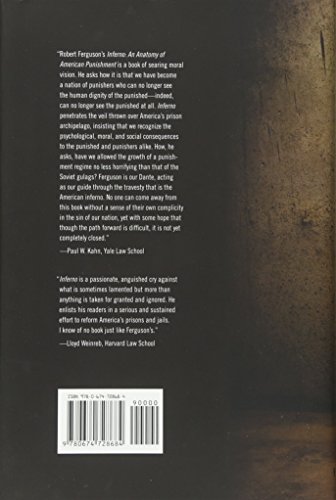
Robert Ferguson's book on the American criminal justice system, Inferno: An Anatomy of American Punishment (Harvard University Press, 2014) ought to be must reading for every legislator, judge and prosecutor in the United States. You will note that I did not include criminal defense lawyers in the list of people who need to read this book -- that is because they already know the truth Ferguson speaks: the criminal justice system is a wasteful failure.Drawing from literature, moral and political philosophy, legal scholarship and reported cases, the book asks questions that are too often neglected: what is it about punishing others that we find so enjoyable? Is this social sadism really an effective source of public policy? Shouldn't we be working to dismantle a prison-inudstrial system that dehumanizes not just prisoners, but other participants in the system as well?The fact is, we enjoy the punitive impusle. Ferguson notes that no less an authority than St. Thomas Aquinas tells us so. "In order that the happiness of the saints may be more delightful to them and that they may render more copious thanks to God for it, they are allowed to see perfectly the suffering of the damned," Aquinas wrote in the Summa Theologica.Indeed, we so love to punish that we've coined a series of toxic aphorisms: "Lock 'em up and throw away the key;" "If you can't do the time, don't do the crime." Read the anonymous comments published by haters after just about any online report of a crime to a glimpse of something raw and toxic. We're exception, all right, in this the land of the free and home of the brave -- we excel at blind hatred. In an uncanny way, the righteous exude the same hostility as the damned: It's hard to tell the difference between Jack Abbott's raging prose in the Belly of the Beast and the vitriolic spume of the law and order crowd railing agains criminal defense laywers.Ferguson notes three dismal truths about punishment in the United States: We enjoy the spectacle, punishments always seem to increase, and participants in the process, and the public at large, avoid looking at the consequences of punishment. Readers unfamiliar with the work of the late William Stuntz will learn about what Stuntz called "the pathological politics of criminal law" in his seminal University f Michigan Law Review article of that title in 2001.I read this book with a great sense of relief. As a practitioner, I often wonder whether, to paraphrase Nietszche, an author on whom Ferguson relies greatly, I have stared so long into the abyss that the abyss now defines my perspective. Not so, Ferguson suggests -- the abyss is not an idiosyncratic perspective, the abyss is us -- we've permitted a cancer to grown without our midst, we punish without thinking, enjoying the severity of it all, and waste the lives of all who participate pretending that it is justice we are seeking.Ferguson teaches at Columbia, but he has the soul of a practitioner. I cannot recommend this book highly enough.
D**E
Not a fun read, but worthwhile
My book group chose INFERNO as our book to read this month. I've previously read very little about America's prison system, and began reading with an open mind. Here are some thoughts:* This is an important topic, and I'm glad I read the book. I now find myself paying more attention to news items about prisons and sentencing, and discussing the subject with friends, so it definitely had an impact on me. The author was successful in getting me to think about something I didn't really want to think about.* It's well-researched, with lots of relevant data and copious footnotes citing references and source materials.* The author's style, for me, was overly academic. I often felt like I was reading a term paper or master's thesis. I kept reading, but it was a bit of an effort.* Once you get past the first 50-60 pages the book becomes more readable ... stick with it.* The parts of the book having the most impact on me were those which related historically (e.g., Supreme Court decisions), experientially (e.g., sad cases of people sentenced overly harshly to life imprisonment due to "three strikes and you're out" legislation), and from other literature (e.g., Dante's DIVINE COMEDY, Abbott's BELLY OF THE BEAST, Melville's BILLY BUDD, and even the BIBLE).* Had I been the editor of this book, I would've suggested starting with Chapter 5 (which describes the inordinate amount of suffering in prisons) rather starting with definitions and theory. As I began the book, the author's style struck me as polemic, but I didn't know why he was so angry. Had he started with Chapter 5, I would've been right there with him instead of resisting the message.
H**Z
Burning read
This is an in-depth exploration of the psyche of the punisher in America. This fascinating book about punishment is not about the competing theories of why we punish or how we should punish. It is about why the urge to punish - and punish so severely. It examines all the institutions that have a role in the punishment regime - from the legislature to the police, the prosecutor, the court, and the prison guard. Ferguson studies the people in these institutions to help the reader understand why the American culture for punishment is so strong, and what can be done so that the punishment of offenders will be fairer and more just.Ferguson forces the reader to think about the punishment meted out to offenders more deeply. When the prison guard takes the criminal away after the court has handed down the sentence, the punishment begins for that criminal. But to the rest of the society, that is the end of the story. Do we know what happens after sentence is passed? That is the compelling question that Ferguson tries to answer.
W**R
Terrific book if U R interested in the topic
I am a psychotherapist writing a report for a clemency hearing for an incarcerated patient of mine. I bought this book to gather certain statistics and to review penal theory, but I got much more. I got a remarkable comparison of the current American penal system to Dante's "Inferno." Very well done. I also picked up a few CHILLING factoids I could have done nicely without knowing. For example, did you know that when prison officials execute a human being in your and my name, they plug his or her butt in order to ensure no loose bowels when you die. How perfectly dreadful it would be for a man to s*** in the execution chamber.
Trustpilot
2 months ago
3 weeks ago