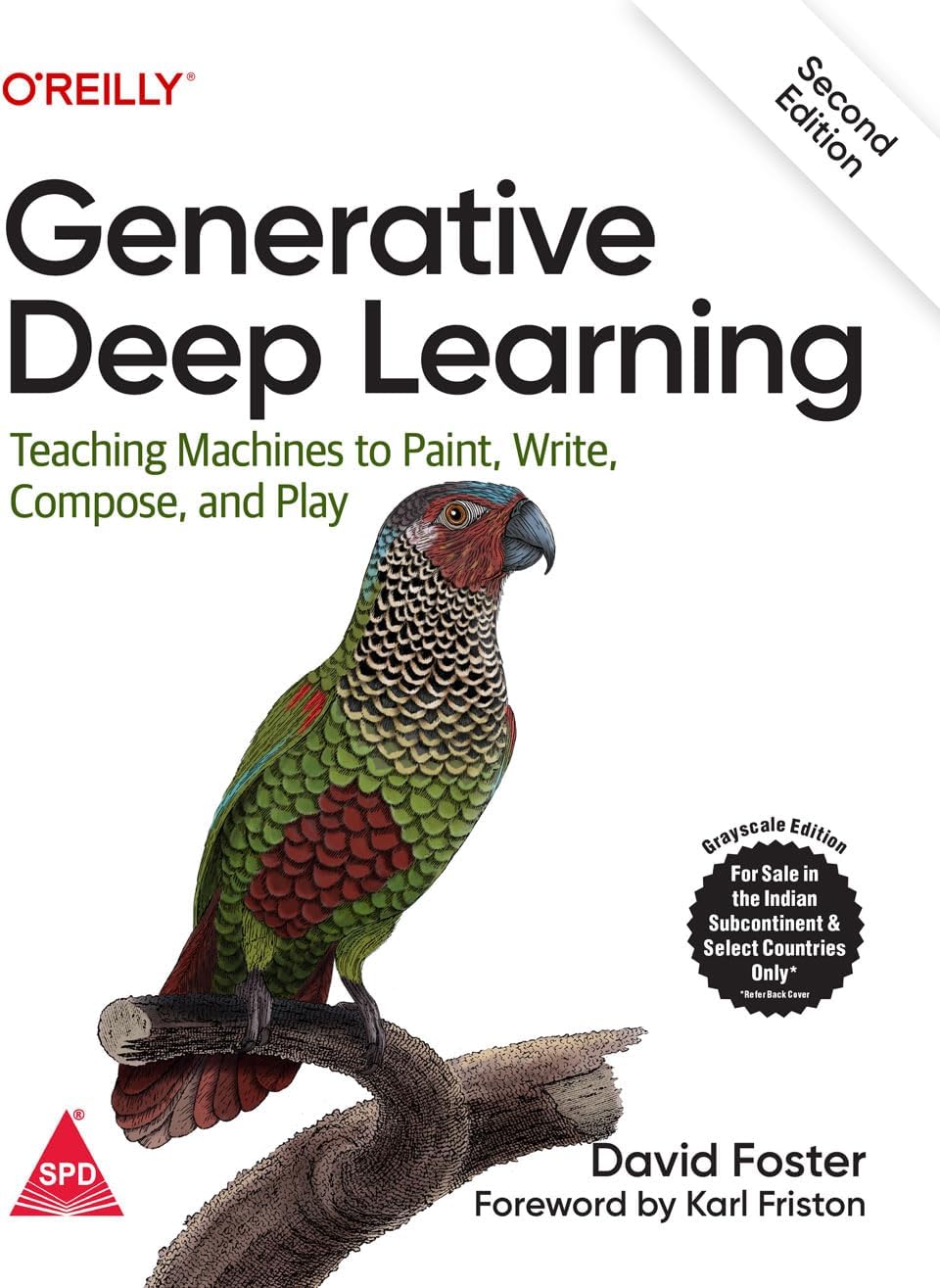
Generative Deep Learning: Teaching Machines To Paint, Write, Compose, and Play, Second Edition (Grayscale Indian Edition)
Product ID: 542829396
Desertcart purchases this item on your behalf and handles shipping, customs, and support to Kenya.
Disclaimer Shroff Publishers do not endorse the preview pages of kindle linked to our ISBNs. All Indian Reprints of O'Reilly are Printed in Grayscale. Generative AI is the hottest topic in tech. This practical book teaches machine learning engineers and data scientists how to use TensorFlow and Keras to create impressive generative deep learning models from scratch, including variational autoencoders (VAEs), generative adversarial networks (GANs), Transformers, normalizing flows, energy-based models, and denoising diffusion models. The book starts with the basics of deep learning and progresses to cutting-edge architectures. Through tips and tricks, you'll understand how to make your models learn more efficiently and become more creative. Discover how VAEs can change facial expressions in photos Train GANs to generate images based on your own dataset Build diffusion models to produce new varieties of flowers Train your own GPT for text generation Learn how large language models like ChatGPT are trained Explore state-of-the-art architectures such as StyleGAN2 and ViT-VQGAN Compose polyphonic music using Transformers and MuseGAN Understand how generative world models can solve reinforcement learning tasks Dive into multimodal models such as DALL.E 2, Imagen, and Stable Diffusion This book also explores the future of generative AI and how individuals and companies can proactively begin to leverage this remarkable new technology to create competitive advantage. Review: A comprehensive guide to Gen AI that I needed! - Very glad I chanced upon this book. This guide to state-of-the-art Gen AI research is both comprehensive and deep. It helps you grasp the underlying architecture, building blocks and mathematical intuition of wide variety of gen AI models (ranging from text to images to music to multi modality models). The book expects some background and intuition in stats and probability theory. It can be a heavy read at times but that's when you know this has the depth to actually get what's going on in these models and not just learn to call a few APIs in a phyton program. Although, it does include a set of coding exercises too. Strongly recommended. Review: Excellent book - Excellent book
| Best Sellers Rank | #27,781 in Books ( See Top 100 in Books ) #93 in Artificial Intelligence |
| Customer Reviews | 4.5 out of 5 stars 218 Reviews |
A**N
A comprehensive guide to Gen AI that I needed!
Very glad I chanced upon this book. This guide to state-of-the-art Gen AI research is both comprehensive and deep. It helps you grasp the underlying architecture, building blocks and mathematical intuition of wide variety of gen AI models (ranging from text to images to music to multi modality models). The book expects some background and intuition in stats and probability theory. It can be a heavy read at times but that's when you know this has the depth to actually get what's going on in these models and not just learn to call a few APIs in a phyton program. Although, it does include a set of coding exercises too. Strongly recommended.
S**L
Excellent book
Excellent book
S**.
Great book
Great book content wise but the build quality could have been better
S**J
Black and white book
The book is best for starting of learninggenerative model structures. However it came as black and white and I think that's the only thing that bothered me. Had I wanted to get it in greyscale I would have got a pdf from someone and got it printed. So I think there should be a coloured version too.
A**N
Great explanation of all key concepts
...of Deep Learning...e.g.Generative vs Discriminative Learning, Encoding vs Decoding...also comes with basic code to try things out on laptop or Google Colab free layer
S**U
A superb, practical book
An excellent, practical book for deep learning practitioners.
R**N
Lack of a critical aspect
Although the book covers many key techniques in generative AI, a key question needs to be answered, how do we know if it's generating a good quality image other than by eyeballing it? There should be a section that talks about the joint use of the discriminative model and generative model, for example, if we were using the generative model to augment the dataset for the downstream discriminative task (image classification), how do we evaluate the generated data has been helpful, some may say just look at the performance difference of downstream task, but I bet there is more insight than that, author need to consider this problem in future edition.
S**A
Excellent review of types of deep learning models for generative tasks
In 2019 I bought, read and thoroughly loved the first edition of this book. One reason I loved that edition was the author’s excellent way of explaining generative adversarial networks (GAN), with humorous and relevant examples. At that point I was a lot more naive about the various deep learning models (ANN, RNN, CNN etc) and for a while I was unable to see where GANs fit in in the grand scheme or evolution of deep learning models. With the explosion in interest in generative AI after the release of ChatGPT-3, I read “Natural Language Processing with Transformers” by Turnstall etc. to get an understanding of the Transformer model. Along the way I read other sources of information on language models such as a paper “Survey of Large Language Models” by Socher etc. That later paper gave an excellent overview of the evolution of language models (statistical language models --> neural language models --> pretrained language models —> large language models). I also saw where language models fit in in the context of ANNs, RNN, CNN etc. When I saw that the author released a second edition of “Generative Deep Learning”, I noticed that the content had changed (ie increased) from the first edition, and I immediately decided to buy the second edition. This second edition has an excellent overview of the evolution of generative models, in fact 6 of them (variational auto encoders (VAE) —> generative adversarial networks (GAN) —> autoregressive models —> normalizing flow models —> energy based models —> diffusion models). I had never heard of some of these models. According to this author the Transformer is an application of generative deep learning models. The author goes on to describe other applications such as music generation and multimodal models. While this book requires one to know Python programming and offers code on GitHub, I was able to skip running the code and still learn a lot about generative deep learning. (I tried to run the code examples but couldn’t get around to it. I wish the author provided easier Jupyter notebooks for running the code). Another aspect of the book that I loved was the author’s description of key concepts like “probabilistic” versus “deterministic”, “discriminative” versus “generative” etc. I highly recommend this book as a great resource for a historical overview of generative deep learning. One should read it before one reads anything on just the transformer or language models.
C**N
Great read with good structure to learn the theory and good guidance for practical tests
This was a great read to understand how generative AI works, at the right level of detail and very much up to date. The content structure is good to learn the theory starting from the basics and then gradually layering the most complex and recent evolutions. The accompanying TensorFlow workbooks help with practical examples that can be followed. One negative note: the Kindle version is low quality when it comes to mathematical formulas, impossible to read.
A**O
Muito bom
O autor é muito bom e o conteúdo também. Dá um overview geral da área e implementações em Tensorflow
Trustpilot
3 weeks ago
1 month ago