
Buy anything from 5,000+ international stores. One checkout price. No surprise fees. Join 2M+ shoppers on Desertcart.
Desertcart purchases this item on your behalf and handles shipping, customs, and support to Kenya.
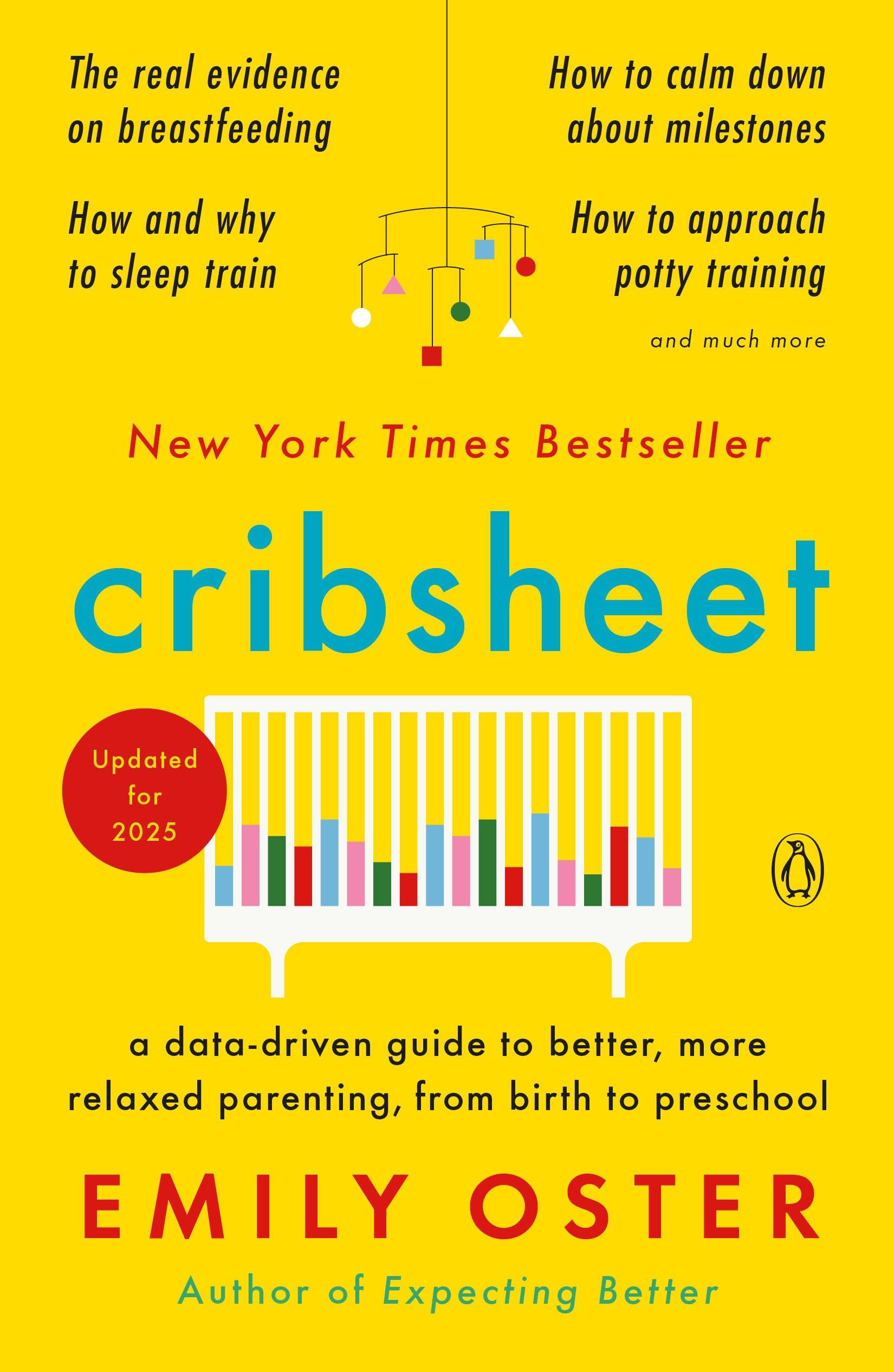
The New York Times bestseller From the author of Expecting Better, The Family Firm , and The Unexpected an economist's guide to the early years of parenting. “Both refreshing and useful. With so many parenting theories driving us all a bit batty, this is the type of book that we need to help calm things down.” — LA Times “The book is jampacked with information, but it’s also a delightful read because Oster is such a good writer.” — NPR With Expecting Better , award-winning economist Emily Oster spotted a need in the pregnancy market for advice that gave women the information they needed to make the best decision for their own pregnancies. By digging into the data, Oster found that much of the conventional pregnancy wisdom was wrong. In Cribsheet , she now tackles an even greater challenge: decision-making in the early years of parenting. As any new parent knows, there is an abundance of often-conflicting advice hurled at you from doctors, family, friends, and strangers on the internet. From the earliest days, parents get the message that they must make certain choices around feeding, sleep, and schedule or all will be lost. There's a rule—or three—for everything. But the benefits of these choices can be overstated, and the trade-offs can be profound. How do you make your own best decision? Armed with the data, Oster finds that the conventional wisdom doesn't always hold up. She debunks myths around breastfeeding (not a panacea), sleep training (not so bad!), potty training (wait until they're ready or possibly bribe with M&Ms), language acquisition (early talkers aren't necessarily geniuses), and many other topics. She also shows parents how to think through freighted questions like if and how to go back to work, how to think about toddler discipline, and how to have a relationship and parent at the same time. Economics is the science of decision-making, and Cribsheet is a thinking parent's guide to the chaos and frequent misinformation of the early years. Emily Oster is a trained expert—and mom of two—who can empower us to make better, less fraught decisions—and stay sane in the years before preschool. Review: Recommend - I enjoyed this book. It’s written in a fun easy to read format. I feel like it made me think about how things I really hadn’t considered yet. I loved all the data. Maybe not the most thorough but very good. I’d recommend Review: LOVE - I love this book and Expecting Better! I genuinely feel like I've learned so much and been able to develop opinions on topics that would have otherwise taken me days to research and try to parse information together. I love the way Emily writes! I think this book is extremely useful for all expecting parents and will be recommending it to friends and family in the future.


| Best Sellers Rank | #964 in Books ( See Top 100 in Books ) #1 in Business Decision Making #4 in Decision-Making & Problem Solving #6 in Pregnancy & Childbirth (Books) |
| Customer Reviews | 4.6 out of 5 stars 7,008 Reviews |
.**.
Recommend
I enjoyed this book. It’s written in a fun easy to read format. I feel like it made me think about how things I really hadn’t considered yet. I loved all the data. Maybe not the most thorough but very good. I’d recommend
M**S
LOVE
I love this book and Expecting Better! I genuinely feel like I've learned so much and been able to develop opinions on topics that would have otherwise taken me days to research and try to parse information together. I love the way Emily writes! I think this book is extremely useful for all expecting parents and will be recommending it to friends and family in the future.
A**R
Much needed data-driven guide to parenting
I want to give this 5 stars - there is a real need for more evidence-based parenting advice. As a parent (and an academic scientist), I keep hearing various rules and recommendations and find myself wondering... where do the data for THAT come from? This book is a really accessible guide to navigating the parenting literature with an eye for research methods. The author also does a wonderful job at discussing how sometimes what parents care about is not what research measures. I also found it quite freeing to know that there is not a lot of evidence for a whole host of things. I'm drawn to attachment parenting practices, and I chose to breastfeed- it felt nice to realize I was doing these things because I WANT to, not because I HAVE to because "the evidence says". The big takeaway, then, is "just do you" - with a few caveats: please vaccinate, do not spank your children. My one criticism is toward the parts that were not grounded in data. The postpartum recovery section seemed to be based on personal experience and anecdotes, and repeated some potentially harmful myths (e.g. about how "capacious" one's vagina is after childbirth). These are admittedly more medical questions than the others dealt with in the book, but I would have liked this section too to be more in the spirit of a critical view of existing evidence. Similarly, the how-to section on breastfeeding strayed too much into the realm of personal experience and unscientific sampling of anecdotes. Overall, though, this is a really wonderful book and I plan on getting it for all future baby showers.
R**Y
Expecting Better
Emily Oster uses the same data-centered approach in Cribsheet that she did in Expecting Better. (You can read my review of that here.) That’s why I loved Expecting Better so I knew I’d love Cribsheet too. Oster wrote Expecting Better after she had her first child and drew on her own experience of pregnancy for that book. She would present the data and explain why she made the choice she did but was never judgmental about it. The choice was ultimately left up to the reader. Cribsheet is the same, only Oster wrote it after the birth of her second child. She knows from personal experience that all children are different and what works for one may not work for another – even if they have the same parents. Cribsheet covers the most heated topics related to a baby’s first year – sleep training, breast vs. bottle, vaccinations, working vs. staying home, etc. The section on toddlers includes walking, talking, potty training, discipline, education and more. Like in Expecting Better, she presents the various approaches to each topic and then her analysis of the available data, without judgment. My oldest child is 16 years old and my youngest is 18 months old. A lot has changed in 16 years. One example is that it’s now recommended that children sleep in the parents’ bedroom for their first year. This blew me away! My older kids were in their own room within weeks of birth and this was pretty much standard at the time. After reading Oster’s section on sleep, I understood why the recommendation had been put into place and was able to decide how long I thought it was appropriate for my new baby to sleep in my bedroom given the available data. I hope that Oster continues to write books as her children grow. I’ll be first in line for all of them!
F**F
Best book for anxious parents-to-be
Much better book than the others I had ordered. This is data driven and far better explained.
M**R
Great book for first time parents!
I wish I had read this book before I had my first baby. This book gives you valuable data for you to make your own decisions without the judgement that you’d get from someone you know. At the end of the day it’s using the information with your personal situation to decide what really works for your family. Great read!
J**L
I love Emily Oster's books
Are you tired of garbage science headlines in the news and anecdotal evidence of what will make your baby smarter? Afraid that someone is going to shame you for sleeping in the same bed as your baby? Or for not sleeping in the same room? Besides summarizing the best research on almost every tough decision you'll judge yourself on, Dr. Oster tells you that you don't have to follow the recommendations. Arm yourself with the facts and the numbers. Then make the decisions for yourself taking into account your own mental health. When someone calls you a terrible mother on Facebook, you can relax knowing that you're the one who took into account the data and that idiot on Facebook probably gets their parenting recommendations from Tucker Carlson. The book isn't all numbers and cold calculations, though. Especially in this second book, Dr. Oster throws in a lot of anecdotes about how she and those she talked to for the book didn't follow some of the recommendations. Sometimes the data says there's a 1 in 10,000 increase in the chance of death, but they felt like that was a risk they were willing to take because they would be careful. Some risks, as Dr. Oster points out, are probably lower than your chances of dying in a car accident on the way to the hospital...meaning don't worry about them. But do drive carefully to the hospital. It's not like the movies. You can take it easy. Surprisingly, more than any other book, this one gave me the best impressions of how things were not going to go as planned. She mostly pulls from her own experiences here, and I was surprised how many things went wrong and how many of the normal childbirth and baby care events were very difficult for her and her husband. The stories have more of an impact than just numbers. This is hard even for the best prepared among us.
S**A
Interesting read, whether it’s data driven or not remains to be decided
As physician scientists we are both very data-driven, and really wanted to like this book. It is mostly okay, 60% of the content is common sense (like the vaccination section) and stuff we already knew, 30% of it basically boils down to “you can do things either way and there’s no tangible benefit or harm”. A few chapters were on contentious subjects where every parent has a different opinion (like sleep training - we would never use the cry it out method and mainly think this sleep training business is just a big racket). The breastfeeding section is what we disliked the most. It’s a touchy subject for many women, and a lot of mothers feel judged and/or guilty (sometimes rightly) about their decision to breastfeed or not, and the anxiety surrounding breastfeeding doubles when going back to work and pumping gets involved. It’s perhaps due to this reason that the author gets really defensive in this chapter, and the advice is based more on personal experience and not really evidence-based. For instance, she talks about how difficult pumping is, and her bottom line is “pumping sucks” - that’s not paraphrased, it’s literally what’s written in the end of chapter summary. You can imagine that it will potentially make the reader anxious about pumping too, if they’re a first time mom. What she should’ve said is “pumping sucks - for me”. There, fixed that for you. There are a few more things in the book that are defensively written and not really data-driven, though I’m having trouble recalling exactly what they were. I do identify with how the author and her husband kept records of everything like feedings and diapers and growth charts, and made graphs with the outputs and analyzed them. It’s the sort of thing we like to do as parents as well. Overall, it’s a fresh perspective. A lot of childcare books, particularly the older ones, have a paternalistic, this-is-how-it’s-always-been type angle, as opposed to scientific basis. However; like I said, this book’s impact is marred by the author trying several times to pass of her personal experiences as evidence-based. Our personal decision was to stick to a up-to-date reference book written by physicians (the AAP’s Caring for your newborn and young child), though this book was definitely an interesting read.
D**N
El título del libro lo dice todo
Es un libro que si buscas ser madre en EUA te ayuda pero te sirven pocos capítulos si no vives allá. Aún así, es interesante aprender las dinámicas y estadísticas del proceso de criar hijos desde el embarazo hasta que son infantes.
C**A
i do recomend!
I loved!! I recomend to all my friends This book fare perfect for new parents! Easy to understand And read!!
R**F
A must read
Highly recommended. It's no "in my opinion" or "my grandma told me" nonsense you read elsewhere. This is evidence-based talk deeply grounded in science. Cheery on the cake, it's very well written, easy to digest, and very hard to put down once you start chewing through the pages.
A**A
Ottimo alleato
Un libro che fornisce moltissime informazioni soprattutto basate su raccolta dati! Alcune cose sono molto basate sulla popolazione degli USA ma questo non toglie che i dati rimangono validi anche per certi aspetti. Consiglio questo libro anche per iniziare a leggere qualcosa di strutturato.
L**A
Must have for parents/expecting parents
A well written book that breaks down common topics around parenting and caring for your newborn/infant. There’s a lot of chatter and anecdotal information that gets thrown at you and it’s overwhelming. This summarises and presents facts using statistics in a way that’s digestible, less biased and easy to understand.
Trustpilot
1 month ago
4 days ago