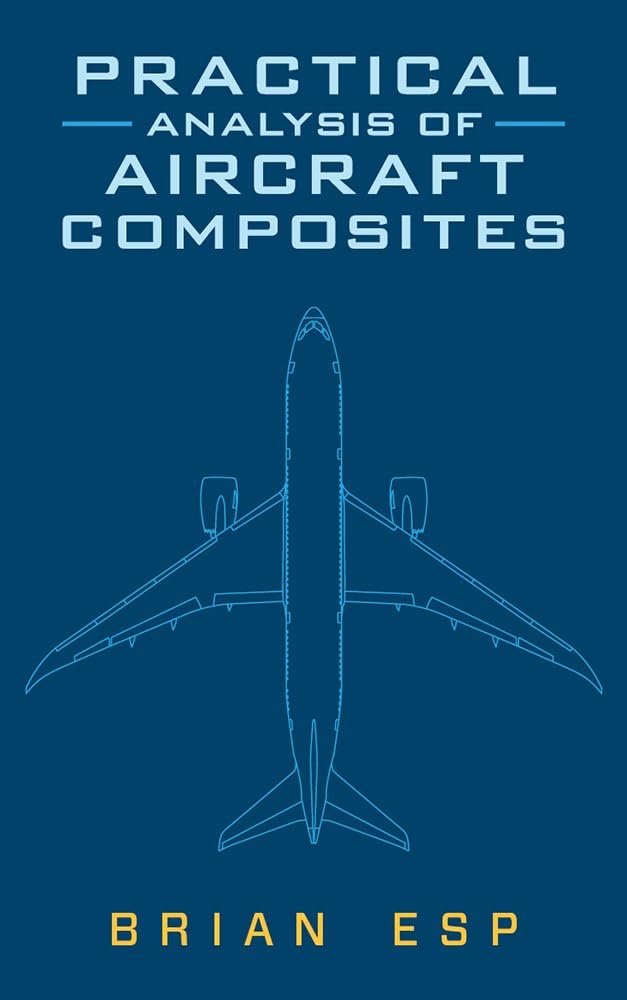


Practical Analysis of Aircraft Composites
Desertcart purchases this item on your behalf and handles shipping, customs, and support to Kenya.
Description
Practical Analysis of Aircraft Composites is a comprehensive guide to the analysis of composite aircraft materials,combining theory with proven practical approaches. Invaluable to both practicing professionals and academics, Practical Analysis of Aircraft Composites covers a wide variety of topics including: Basic mechanics of composite materials Principles of Classical Laminate Theory Unnotched strength prediction and notched strength prediction Analysis methods for mechanically fastened joints Bonded joint analysis for both metal and composite adherends Stability solutions for laminated plates and built-up structures Composite beams and sandwich structures Unique mechanical properties of composites Structural requirements and structural substantiation for aircraft composites Practical aspects for Durability and Damage Tolerance (DaDT) Standard design practices for laminates, joints, and sandwich structures
Specifications
| Dimensions | 9.7 x 6.5 x 2 inches |
| Edition | First Edition |
| Isbn 10 | 0983245398 |
| Isbn 13 | 978-0983245391 |
| Item Weight | 3.3 pounds |
| Language | English |
| Print Length | 737 pages |
| Publication Date | October 1, 2017 |
| Publisher | Grand Oak Publishing |
Reviews
User
One of the Best Books on Composites
The book arrived in perfect condition and was carefully packaged.As for the content, I believe it is one of the best texts on composite materials. It contains a wealth of information, explanations, and methods that are not easily found elsewhere.I would highly recommend it both to those approaching the subject for the first time and as a valuable reference for professionals.
User
Straightforward, practical, comprehensive & integrated. Exactly what the industry needed.
The author presents the complex subject of composite structures design & analysis in a straightforward manner, such that any practicing engineer, researcher, or student can understand on the first read. Among plethora of composites books out there, this one truly sets itself apart in a number of ways.First of all, unlike other books, I have found this one to be much easier to read and follow. Complex theories and concepts are unpacked with easily understood explanations in a straightforward manner, and all the figures and plots are self-explanatory. Also, unlike other books, the nomenclatures and notations are consistent, make sense, and are easy to follow. This is especially helpful when you're trying to follow the complex matrix manipulations in the lamination theory.Secondly, the book looks at the composites in a comprehensive and integrated way. It has dedicated chapters and discussions to the classical lamination theory, practical composites design and analysis methods, testing, manufacturing, repair, fatigue, and DADT of composites, and more. The rich discussions also provide in-depth understanding of how one aspect of composites may influence the others (ex. how manufacturing faults and damages may influence structural integrity, and therefore, your analysis, and how different levels of structural testing tie into failure analysis, etc.). This has the effect of teaching you to think about the composites as a holistic and integrated set of engineering problems, instead of disjointed ones. In addition, the chapters are ordered in a way that new concepts build on previous chapters.Lastly, this book is truly unique in that it has clear explanations on how composites are different from metals. Chapter 2, in particular, is dedicated to this topic, with more specific discussions offered in pertinent chapters. Readers can benefit from these and learn to visualize the less-than-intuitive behaviors of the composites. If you're used to dealing with metallic structures and are transitioning to the composites, this is a must read. My guess is that the book will soon become an industry standard, similar to Flabel or Bruhn in metallic structures analysis.There is no need to buy multiple composites books anymore. This one can replace them all.
User
Great Book!
Firstly, let me state that book arrived in good shape thanks to Amazon. It's a hardcover and is printed on good quality paper which will last for years in your reference library.Lets get to the review of the book itself. The book presents an excellent overview of composite laminated structures' analyses, specially for the aerospace industry. The book doesn't delve in to analytical procedures, although several simple examples are provided to illustrate the methodology of application of expression/equations. The value of the book lies in the author's vast experience with the aerospace industry composite analysis methods and the subsequent capturing of the same in to the book. The explanations are concise and in only a few instances, I found a better explanation or more clarity was required. Another value of the book is presenting various practical aspects of analysis which differs from the academic methods presented in other composite text books. Several insights which may be subtle but very important are provided which may be of great help.I have to state that book presents the important & relevant content for each topic but doesn't go in to very deeper details. Using the information from the book, the candidate can explore other resources to get a deeper understanding.Although I was quite familiar with composite stress analysis methods, I found several chapters new & illuminating. Part 2 of the book was quite good as well in presenting the overview of the various requirements against which a structure needs to be designed.I wish the author had presented a few topics regarding the practical aspects of composite analysis using FEM. Although, the analytical calculation part of composites can get hefty, I wish the author had presented a couple of scenarios of designing a structure using the principles from earlier chapters. For example, coming up with an optimal laminate layup of a typical stiffened panel or a Wing Spar beam...illustrating how to arrive at a compromise for various conflicting requirements etc. Would have given us some further insight on application of stressing or design principles to come up with usable structures.I would recommend this book to anyone keen on improving their knowledge about practical aspects of composite analysis. A must have reference book"
User
Brian's book is very comprehensive.
I grew up in sailplanes. Sailplanes led the way for composites in aircraft going back into the 1960's. I filament wound two 1/4 scale sailplane fuselages at Martin Marietta in the 1960's. I did a lot of composite analysis for five years on Boeing's B2 Stealth Bomber. Composite analysis was then very much in its infancy. I used three computer systems to generate the margins of safety for each ply. Subsequent corporate, Academic, and Professional Organization research, testing, etc. have shown the weaknesses of that approach.Since those days the superiority of laminate analysis has been shown, but there are a number of approaches that have been tried. The beauty of Brian Esp's work is that it very comprehensive. There is an immense amount of work that many have done to advance the analysis of composites including composite joints and mixed metallic/composite joints over the years. Also, in aircraft particularly, composite structure is mixed with metallic structure greatly complicating analysis.Brian's work looks at most of these areas and brings out their strengths and weaknesses in both his book and in his course lessons. I have taken his course, bought his book and downloaded some of his software. What's most impressive is that the book, the course and the software are coordinated together in a manner I've never seen in my 50 years as an Aerospace Engineer. Actually, 56 years! My wife and I were married Christmas Eve in 1964 during my Christmas break from Boeing, Seattle. Today is Christmas Eve 2020, our 56 Anniversary.
User
Academic theory to practical industry methods
This book provides a comprehensive review of everything you would learn in a university class and then transitions to how the aerospace industry takes that information and applies it in realistic situations. The amount of information almost seems overwhelming but I found that the answers to several of my questions were just a few pages away.Esp constantly references chapters forward and backwards to link the material, which helped to build a more thorough understanding and to simply find the applicable analysis method. Also, each chapter is filled with references to outside sources to back-up the analysis methods provided and to provide more direction on tangent topics.After more than a decade in the aerospace industry, this seems to be one of the most comprehensive analysis books that I've read to capture analytical methods, design guidelines, certification, and reasoning behind it all.
User
Great reference for composites. Great quality book.
In addition to buying the book and also took Brian's course and use some of his software. Every aspect of his work is very impressive. Super practical and useful. Lastly, the quality of the book binding is super nice. It is frustrating when you have a great content with poor quality book manufacturing. This book will last many many years. I highly recommend it. Thanks.
User
Excellent resource for all skill levels.
Practical Analysis of Aircraft Composites is an extremely comprehensive resource for individuals of all skill levels. As more of a freelance learner at this point in my career, this book opens the door to an fairly inaccessible discipline. Having minimal exposure to composite analysis (and especially industry practices) in both my undergraduate and graduate education, this textbook approaches the analysis of composite structures in a masterful manner, balancing complexity and practicality.I am nearly halfway through the text, and am very much enjoying the journey!
User
Clearly Written and Directly Applicable
I am a practicing engineer who, more and more, is becoming involved in the assessment of structures composed of composite materials. "Practical Analysis of Aircraft Composites" by Esp has become my first stop whenever I need to familiarize myself with some aspect of the analysis of composite materials. This book helps me to understand the principles and develop a route to a solution. It is my go-to composites reference book, and I recommend it to anyone who needs to be aware of the analysis of composites in practice.
Common Questions
Trustpilot